
Your furnace dies on the coldest night of January. The repair quote arrives, and suddenly you’re staring at a $2,400 bill for a compressor that you assumed was covered. This scenario plays out for Delaware homeowners every year, and almost every time, the cause is the same: misunderstanding what an HVAC warranty actually covers. A warranty isn’t just a piece of paper tucked into a folder. It’s a financial safety net with real rules, real exclusions, and real consequences if you don’t follow them. This guide breaks down everything you need to know, so you can protect your comfort and your wallet without the guesswork.
Table of Contents
- What is an HVAC warranty and how does it work?
- Types of HVAC warranties explained
- What’s excluded and how to avoid coverage pitfalls
- Delaware specifics: Local practices, laws, and builder warranties
- Is an extended or home warranty worth it in Delaware?
- Cutting through confusion: What Delaware homeowners really need to know
- Protect your home with trusted HVAC warranty services
- Frequently asked questions
Key Takeaways
| Point | Details |
|---|---|
| Coverage varies by type | Manufacturer warranties cover defects, while home warranties cover wear and tear and extended warranties fill gaps. |
| Labor is rarely included | Labor costs are not covered by most standard HVAC warranties, making maintenance contracts or upgrades important. |
| Annual maintenance is key | Proof of yearly professional maintenance is usually required to keep warranty coverage valid. |
| Local regulations matter | In Delaware, using licensed HVAC contractors is essential for maintaining valid warranty coverage. |
| Extended warranties can save money | They are often worth it for expensive repairs or older systems but always check limitations and exclusions before buying. |
What is an HVAC warranty and how does it work?
An HVAC warranty is a written promise from a manufacturer, installer, or third party that they’ll cover the cost of certain repairs or part replacements if something goes wrong with your heating or cooling system. Think of it like a contract with specific rules baked in. Break the rules, lose the coverage.
There are three main types you’ll encounter:
- Manufacturer warranty: Comes with your new equipment. Covers defects in parts.
- Extended warranty: Purchased separately, often adding labor coverage or extra years.
- Home service contract: A subscription-style plan covering multiple home systems, including HVAC.
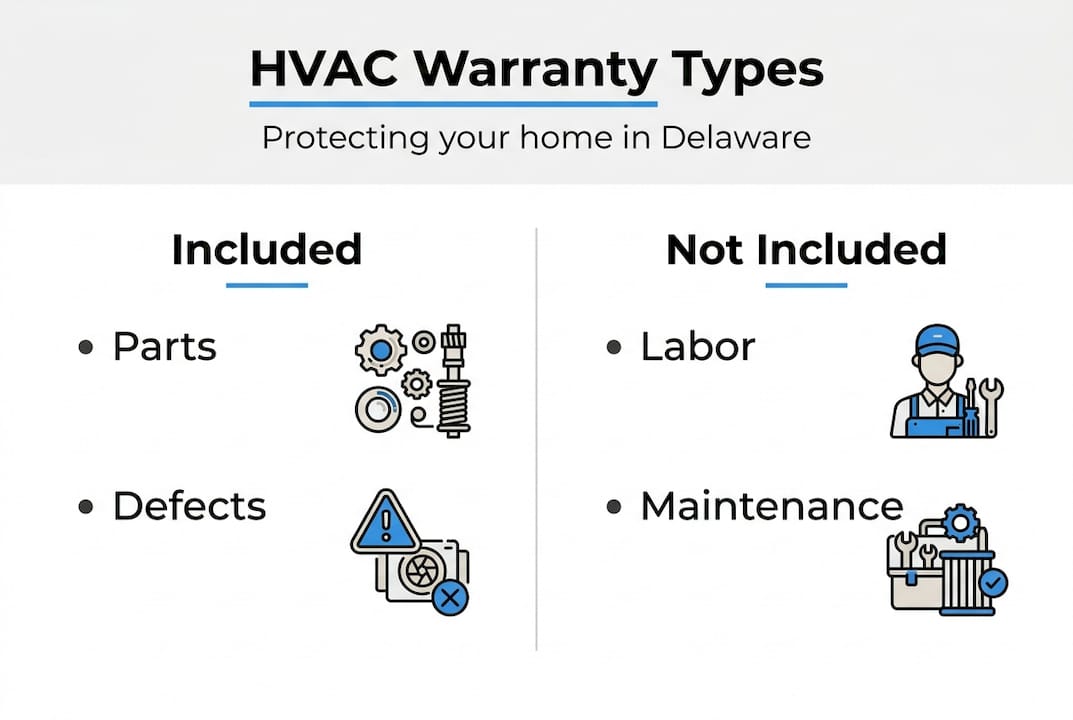
Manufacturer warranties typically cover parts like compressors, coils, and heat exchangers for 5 to 10 years, extendable with registration within 60 to 90 days, but exclude labor, maintenance, refrigerant, ductwork, and improper installation.
Here’s a quick look at what’s usually covered versus excluded:
| Covered | Not covered |
|---|---|
| Defective compressors | Labor costs |
| Faulty coils or heat exchangers | Refrigerant refills |
| Factory-defective parts | Annual maintenance |
| Registered equipment failures | Ductwork repairs |
Common warranty exclusions trip up homeowners who assume their coverage is broader than it really is. Read your documentation carefully before assuming anything is included.
Pro Tip: Always schedule HVAC system tune-ups with a licensed technician and keep every receipt. If you ever need to file a warranty claim, that paper trail is the difference between approval and denial.
Types of HVAC warranties explained
Not all warranties work the same way. Knowing how each type is structured helps you figure out which combination fits your situation best.
| Type | What it covers | What it misses | Typical cost |
|---|---|---|---|
| Manufacturer | Defective parts only | Labor, maintenance, refrigerant | Included with unit |
| Extended | Parts and labor (varies) | Pre-existing issues | $285 to $940 total |
| Home warranty | Normal wear and tear repairs | Equipment over coverage cap | $400 to $800/year |
Each type has its own strengths and blind spots:
- Manufacturer warranty is your baseline. It’s free, but it only catches factory defects, not wear and tear.
- Extended warranty fills the labor gap, which is huge since HVAC repair costs for a single visit can exceed $1,000.
- Home warranty covers repairs from normal aging, making it valuable for older systems, but comes with annual fees and service call charges.
Home warranties cover HVAC repairs due to normal wear and tear, often with a $2,000 to $6,500 cap per system, cost $400 to $800 per year plus service fees, and are distinct from manufacturer warranties that cover defects only.
Worth knowing: Many homeowners assume one warranty covers everything. In reality, combining a manufacturer warranty with a home service contract gives you the most complete protection, covering both defects and age-related breakdowns.
Before signing anything, ask the questions for your HVAC contractor that reveal what’s really in the coverage. Look at HVAC warranty costs to benchmark what you should expect to pay for extended plans.
What’s excluded and how to avoid coverage pitfalls
This is where most homeowners lose their coverage without realizing it. Exclusions aren’t buried in fine print to be sneaky. They’re standard policy, and ignoring them is costly.
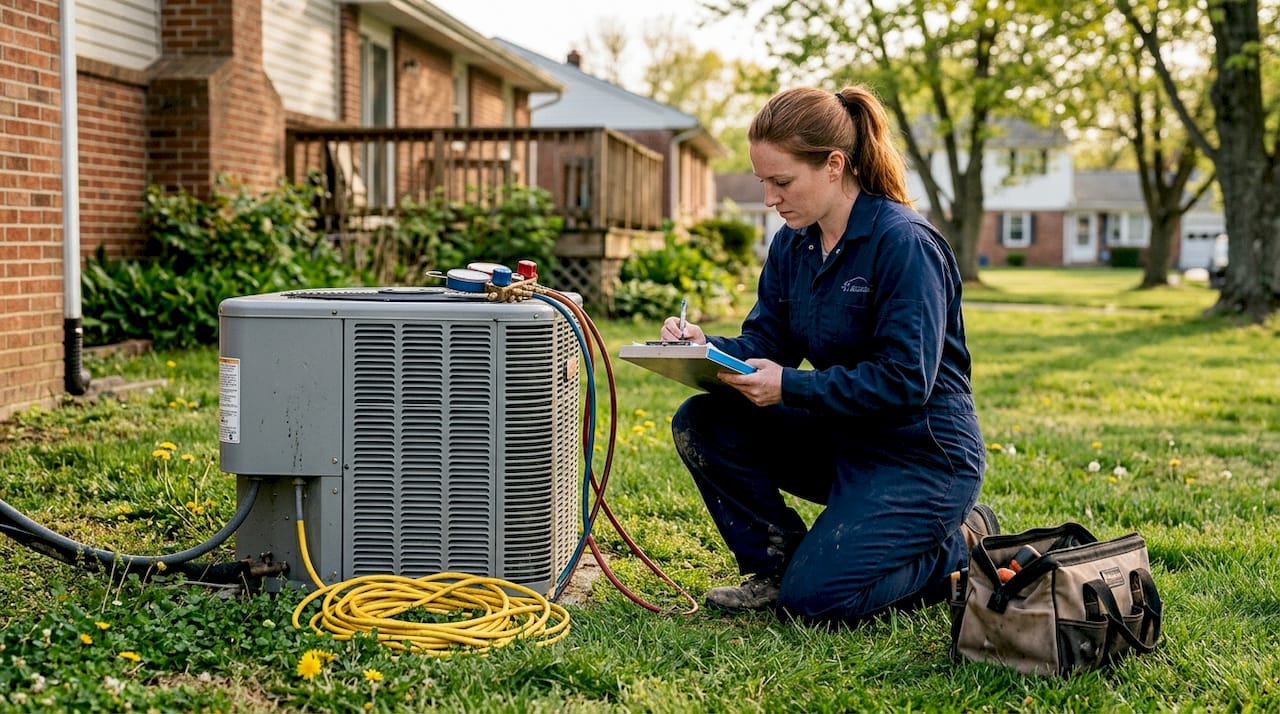
Common exclusions include lack of maintenance, which requires annual proof, as well as improper installation, acts of God, flood, mismatched systems, window units, and failure to register or maintain, all of which void coverage.
Here’s how to keep your warranty valid from day one:
- Register your equipment immediately. You typically have 60 to 90 days after installation. Missing this window can cut your coverage from 10 years down to 5.
- Schedule annual professional maintenance. Most manufacturers require documented proof of yearly service by a licensed technician.
- Use only licensed HVAC technicians. Unlicensed installs void coverage outright. This isn’t negotiable.
- Avoid mismatched equipment. Pairing an older air handler with a new condenser can void both units’ warranties.
- Keep records of everything. Save invoices, maintenance reports, and installation documents in one folder.
Pro Tip: Create a dedicated home folder, physical or digital, labeled with your HVAC system model and serial number. Every time a technician visits, add the invoice. If you schedule HVAC maintenance and repair consistently, you’ll have exactly what manufacturers ask for when a claim is filed.
Statistic to remember: Compressor replacement labor alone runs $1,500 to $2,800. One missed maintenance appointment could cost you that coverage.
Delaware specifics: Local practices, laws, and builder warranties
Delaware doesn’t have unique HVAC warranty laws that set it apart from other states. That’s actually good news for simplicity, but it means you need to lean on federal protections and local practices.
No Delaware-specific HVAC warranty laws have been found. The state follows general U.S. standards, including the Magnuson-Moss Warranty Act. Contractors must be licensed under the Delaware Board of Plumbing/HVACR, and new homes may include builder warranties covering one year of systems coverage.
Here are Delaware-specific best practices every homeowner should follow:
- Always verify your contractor holds an active Delaware HVACR license before any work begins.
- Ask for a written warranty from both the manufacturer and the installer.
- For new construction, review builder warranty documents before closing. Systems coverage often lasts just one year.
- Keep the Delaware Board of Plumbing/HVACR contact info on hand if a licensing dispute arises.
- Check whether your equipment meets current HVAC installation standards to prevent warranty issues from faulty setup.
Delaware homeowner note: If you’re in a new development in New Castle, Kent, or Sussex County, builder warranties for HVAC systems are often limited to one year. After that, you fall back on the manufacturer warranty, so registration timing matters even more.
Neighboring states like Maryland and New Jersey follow similar federal baselines, though contractor licensing structures differ slightly. In Delaware, the licensing requirements are clear, and using an unlicensed technician is one of the fastest ways to void your coverage.
Is an extended or home warranty worth it in Delaware?
Let’s get practical. Is spending extra money on coverage actually worth it for your home?
Extended warranties cost $285 to $940 for 5 to 10 years of parts and labor coverage, making them worth it for high-risk components like compressors, which cost $1,500 to $2,800 in labor alone. Home warranties tend to be better for older systems.
| Scenario | Best option | Why |
|---|---|---|
| New system, 1 to 5 years old | Manufacturer + extended | Labor gap coverage matters most |
| System aged 6 to 10 years | Home warranty | Wear and tear coverage becomes critical |
| Complex system (mini-split, heat pump) | Extended + home warranty | More components, more risk |
| Tight budget | Manufacturer only | Keep records, maintain annually |
Who benefits most from extended or home warranty coverage:
- Homeowners with older systems approaching the 10-year mark.
- Households in older Delaware homes with original HVAC equipment.
- Families who can’t absorb a surprise $2,000+ repair bill.
- Anyone with a heat pump or ductless mini-split system that has more components to fail.
Before purchasing extra coverage, compare your home warranty benefits against realistic repair estimates. Also read the fine print for caps, pre-existing condition clauses, and what service fees apply per visit. Reviewing comparing HVAC service costs locally helps you judge whether a plan’s annual cost is justified.
Cutting through confusion: What Delaware homeowners really need to know
After years of serving Newark and the surrounding Delaware communities, we’ve noticed a pattern. Homeowners spend a lot of energy comparing warranty lengths and prices. They almost never read the exclusions section first. That’s exactly backwards.
The length of a warranty means nothing if a skipped tune-up voids it. The price of an extended plan is irrelevant if a pre-existing condition clause eliminates your claim. We’d rather see a homeowner with a basic manufacturer warranty and three years of documented maintenance than someone with a premium plan who can’t produce a single service record.
The hidden cost trap shows up in year two or three. Labor rates, refrigerant fees, and diagnostic charges add up fast once that first-year honeymoon coverage expires. Most families don’t plan for this until the bill lands.
Our honest advice: register your unit the week it’s installed, schedule maintenance every fall and spring, and always ask what to ask your contractor before any service visit. Pair solid manufacturer coverage with a home warranty for older systems. That combination outperforms buying the longest extended plan without any maintenance to back it up.
Protect your home with trusted HVAC warranty services
Understanding your warranty options is a great first step, but acting on that knowledge with the right local partner makes all the difference. At Enhanced Heating & Air Conditioning, we help Newark, Delaware homeowners navigate manufacturer requirements, registration deadlines, and maintenance schedules so your coverage stays intact.
Whether you need a seasonal checkup, a new installation, or just want to understand your options better, our team is ready to help. Explore HVAC services in Newark, DE or review HVAC service maintenance plans to keep your system running and your warranty valid. Not sure where to start? Check out the questions for your HVAC contractor before your next service visit.
Frequently asked questions
Does my HVAC warranty cover labor and maintenance?
Most manufacturer warranties exclude labor, maintenance, refrigerant, and ductwork, so you’ll need a separate extended plan or home service contract to cover those costs.
Are there special HVAC warranty laws in Delaware?
Delaware has no state-specific HVAC laws beyond federal standards, but contractors must hold an active Delaware HVACR license for any repairs or installations.
What voids my HVAC warranty the fastest?
Skipping registration, missing annual maintenance, or hiring an unlicensed installer voids most manufacturer warranties immediately and permanently.
Is a home warranty worth it for an older HVAC system?
Yes, a home warranty is often the smarter choice for older systems because it covers normal wear and tear repairs that manufacturer warranties no longer address after the coverage period ends.
How do I keep my HVAC warranty valid?
Register your unit within 60 to 90 days, schedule annual maintenance with licensed technicians, and save every invoice and service record in a dedicated folder.

Joe Brooks is the owner of Enhanced Heating & Air Conditioning and has more than 23 years of experience serving homeowners and businesses in and around Newark Delaware. Over the past two decades, Joe has built Enhanced Heating & Air Conditioning by helping customers with heating, air conditioning, indoor air quality, HVAC maintenance, and system installation needs. His articles draw on years of hands-on industry experience and the real questions Enhanced customers ask about keeping their homes comfortable, efficient, and reliable. Joe and the Enhanced team serve Newark and communities throughout New Castle County and the surrounding Delaware area.