
Find the Best HVAC System for Your Home: Types Compared
Picking the right HVAC system feels overwhelming when every brand promises peak efficiency and every contractor pushes a different solution. Gas furnace, heat pump, mini-split, geothermal — the options multiply fast, and so do the technical terms. For homeowners in Newark, DE, the stakes are real: the wrong system means higher utility bills, uneven temperatures, and a costly reinstall down the road. This guide cuts through the noise. We’ll walk you through the key evaluation criteria, explain each major system type plainly, and help you match the right setup to your home’s needs and budget.
Table of Contents
- How to evaluate HVAC systems: Key criteria for homeowners
- Central AC and forced-air furnaces: The classic combination
- Heat pump systems: All-in-one heating and cooling
- Geothermal and other alternatives: Cutting-edge and specialty solutions
- How to compare your options: Summary table and decision tips
- What most homeowners get wrong about HVAC system types
- Get expert HVAC help in Newark, DE
- Frequently asked questions
Key Takeaways
| Point | Details |
|---|---|
| System type matters | Different HVAC systems offer varying levels of efficiency, comfort, and upfront cost. |
| Proper sizing is crucial | A right-sized system ensures lower bills and even temperatures—not too big or too small. |
| Heat pumps shine in DE | Modern heat pumps can cut energy costs and serve as all-in-one solutions for most Delaware homes. |
| Professional advice pays off | Working with an expert ensures the best fit and long-term home comfort. |
How to evaluate HVAC systems: Key criteria for homeowners
Before comparing specific systems, you need a clear set of standards to judge them by. Here are the most important factors to weigh:
-
Efficiency ratings — These numbers tell you how much useful heating or cooling you get per unit of energy consumed. For cooling systems, look at the SEER2 rating (Seasonal Energy Efficiency Ratio). For heat pumps in heating mode, the HSPF2 (Heating Seasonal Performance Factor) applies. Gas and oil furnaces use AFUE (Annual Fuel Utilization Efficiency), expressed as a percentage. The efficiency benchmarks homeowners compare depend heavily on system type, so make sure you’re comparing apples to apples. A higher number is always better, but the jump from good to great can mean real savings over a system’s lifetime.
-
Ducted vs. ductless — Homes with existing ductwork are natural candidates for central systems. Homes without ducts face costly duct installation, sometimes $5,000 or more. Ductless mini-splits skip that entirely. Your home’s layout strongly shapes which route makes financial sense.
-
System sizing — This one gets overlooked more than any other. An undersized system runs constantly and still leaves cold spots. An oversized system short-cycles (turns on and off too fast), wasting energy and wearing out parts quickly. Proper HVAC sizing requires a formal load calculation, not a rough estimate based on square footage.
-
Climate fit — Newark, DE sits in a mixed-humid climate zone. Summers are hot and humid, winters are cold but not extreme. This makes the area well-suited for heat pumps, though very cold snaps still require attention to heating capacity.
“SEER2 applies to cooling systems, HSPF2 to heat pump heating, and AFUE to combustion-based systems — each measures a different type of energy performance.”
Pro Tip: Never accept a quote that skips a load calculation. If a contractor sizes your system based on your old system’s tonnage or a quick square footage estimate, walk away. That shortcut leads to comfort problems and wasted money.
Central AC and forced-air furnaces: The classic combination
Most Newark homes already have this setup: a central air conditioner paired with a gas or electric furnace, both sharing a single duct system. It’s the familiar default, and for good reason.
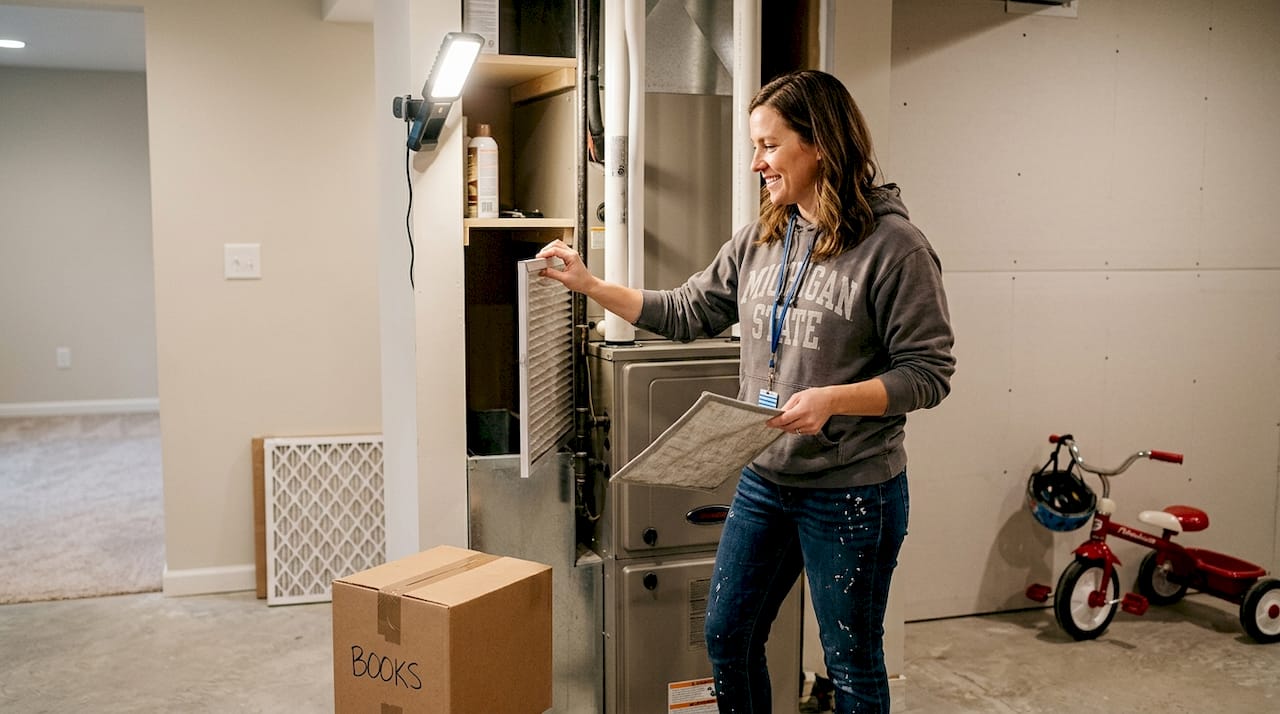
Here’s how it works. The AC uses a refrigerant-cycle process to pull heat out of your indoor air and release it outside — it’s moving heat, not generating cold. The furnace burns gas (or uses electric resistance) to heat air, which gets pushed through ducts to every room. One thermostat controls the whole house.
Advantages of central AC and furnace combos:
- Familiar to virtually every HVAC contractor, making service and parts easy to find
- Provides even, whole-home heating and cooling through a single system
- High-efficiency gas furnaces can reach 98% AFUE, meaning almost no energy is wasted
- Compatible with whole-home air filtration and humidity control add-ons
- Often the lowest upfront cost when ductwork already exists
Disadvantages to know:
- Duct leaks can waste 20% to 30% of conditioned air before it reaches the room
- Forced air circulates dust and allergens if filters and ducts aren’t maintained regularly
- Homes without ductwork face significant installation costs to add it
- Gas furnaces depend on natural gas availability and pricing, which can fluctuate
For homeowners thinking about installing central AC in a Newark home with existing ducts, this system often delivers the best value. Efficiency depends heavily on duct condition, so seal and insulate before installing new equipment.
Pro Tip: Before replacing your system, have your ducts tested for leaks. Sealing leaky ducts can improve delivery efficiency dramatically and may allow you to choose a smaller, less expensive unit.
Regular upkeep also matters. Checking out forced air maintenance tips before each season keeps the system running at peak output and extends equipment life.
Heat pump systems: All-in-one heating and cooling
Heat pumps do something central systems cannot: they handle both heating and cooling in one unit. They move heat from outside air into your home in winter, and reverse the process in summer. No combustion, no fuel — just efficient heat transfer.
Heat pumps can be the most energy-efficient option for home heating and work in both ducted and ductless configurations. In Newark’s climate — where winters are cold but rarely extreme — modern cold-climate heat pumps perform well even below freezing.
| Feature | Ducted heat pump | Ductless mini-split |
|---|---|---|
| Requires ductwork | Yes | No |
| Whole-home coverage | Yes | Zone by zone |
| Installation cost | Moderate to high | Moderate |
| Best for | Homes with existing ducts | Additions, older homes, apartments |
| Zoning capability | Limited without add-ons | Built-in per unit |
Homes where heat pumps shine:
- Older homes without ductwork (mini-splits are ideal)
- Room additions or sunrooms that current systems can’t reach
- Households looking to reduce gas dependence and lower carbon output
- Properties where mini-split zone efficiency allows room-by-room temperature control
One important note: when outdoor temperatures drop well below 20°F, standard heat pumps lose efficiency. A backup electric strip heater is often included, but it’s less efficient. Cold-climate models handle this better, and dual-fuel systems (covered in the next section) pair a heat pump with a gas furnace backup.
For a deeper look at how these systems compare overall, the heat pump vs HVAC breakdown covers tradeoffs in real terms.
Geothermal and other alternatives: Cutting-edge and specialty solutions
Geothermal systems take a completely different approach. Instead of exchanging heat with outdoor air, they exchange heat with the earth through buried loops filled with fluid. Ground temperatures stay relatively constant year-round, making these systems remarkably efficient in any weather.
“Geothermal systems are not limited by outdoor air temperature, which is their biggest advantage over air-source systems during extreme weather.”
Geothermal pros and cons at a glance:
- Extremely low operating costs — typically 30% to 60% less than conventional systems
- System life of 20 to 25 years for the heat pump unit, and 50-plus years for the ground loops
- Eco-friendly with no combustion and very low emissions
- High upfront cost: installation often runs $15,000 to $30,000 or more
- Requires adequate land or drilling access for the ground loop
| System type | Upfront cost | Life expectancy | Operating cost |
|---|---|---|---|
| Central AC/furnace | Low to moderate | 15 to 20 years | Moderate |
| Air-source heat pump | Moderate | 15 to 20 years | Low to moderate |
| Geothermal | High | 20 to 50 years | Very low |
| Dual-fuel | Moderate to high | 15 to 20 years | Low |
The dual-fuel system is worth highlighting separately. It pairs an air-source heat pump with a gas furnace. The heat pump handles most of the load efficiently during mild weather. When temperatures drop low enough that the heat pump becomes less efficient, the furnace takes over automatically. It’s an excellent middle-ground for Newark homeowners who want efficiency but also want reliable cold-weather heat.
For more on the mechanics behind these systems, how geothermal works explains the technology in plain language.
How to compare your options: Summary table and decision tips
Now that each system is on the table, here’s how they compare side by side:
| System | Upfront cost | Efficiency | Needs ducts | Best climate fit |
|---|---|---|---|---|
| Central AC + furnace | Low to moderate | Good (up to 98% AFUE) | Yes | All climates |
| Ducted heat pump | Moderate | Very high | Yes | Mild to moderate winters |
| Ductless mini-split | Moderate | Very high | No | Mild to moderate winters |
| Dual-fuel | Moderate to high | High | Yes | Cold climates |
| Geothermal | Very high | Exceptional | Optional | All climates |
Oversized units waste energy through constant short-cycling, and undersized units run nonstop trying to meet demand. Both outcomes drive up bills and accelerate wear. Sizing matters more than brand.
Questions to ask before you decide:
- Does my home have existing ductwork in good condition?
- What is my primary fuel source, and how stable are local energy prices?
- How long do I plan to stay in this home?
- Do I want room-by-room temperature control, or is whole-home coverage enough?
- What is my total budget, including installation?
- Is my lot large enough for a geothermal loop if that interests me?
- Does my local utility offer rebates for heat pumps or high-efficiency systems?
Reading up on best HVAC installation tips before you meet with contractors also puts you in a much stronger position to ask the right questions. And don’t forget to prepare a list of questions for HVAC contractors so you can compare bids on equal footing.
What most homeowners get wrong about HVAC system types
Here’s an honest observation from years of working with Newark homeowners: most people default to replacing their old system with the same type. Same brand, same fuel, same configuration. It’s familiar, it feels safe, and no one has to think too hard. But that habit quietly costs thousands of dollars over a system’s lifespan.
The bigger problem is trusting brand reputation over installation quality and proper sizing. A premium brand installed incorrectly or oversized by two tons performs worse than a mid-grade brand installed right.
Rising electricity prices and improving heat pump technology make efficiency a long-term financial decision, not just a comfort one. Avoiding costly heating mistakes starts with treating your HVAC choice like a 15 to 20 year investment, because that’s exactly what it is.
Smart homeowners ask for a room-by-room load calculation and get at least three quotes from contractors who explain their sizing logic. That single habit separates homes that stay comfortable for decades from those that need another replacement in ten years.
Get expert HVAC help in Newark, DE
Understanding your options is the first step. The next is getting a professional assessment tailored to your specific home, not a generic recommendation.

At Enhanced Heating & Air Conditioning, we work with Newark homeowners every day to match the right system to the right home. We offer free consultations, transparent pricing, and proper load calculations before recommending anything. Whether you need a full system replacement, an efficiency upgrade, or just want to know your options, our HVAC services in Newark are designed to help you make a confident, informed decision. Explore our expert installation advice or give us a call to schedule your consultation today.
Frequently asked questions
Which HVAC system is the most energy-efficient for Delaware homes?
Air-source heat pump systems are typically the most energy-efficient choice for Delaware homes when properly sized and installed. Heat pumps lead in efficiency for home heating compared to most conventional alternatives.
What is the difference between ducted and ductless HVAC systems?
Ducted systems deliver conditioned air through a network of home ductwork, while ductless systems like mini-splits use individual wall-mounted units without ducts. Ducted vs ductless layouts differ significantly in installation cost and flexibility.
How do I know what size HVAC system I need?
A qualified contractor should perform a full load calculation based on your home’s square footage, insulation, windows, and layout. Proper sizing improves efficiency and comfort, while oversized or undersized units both waste energy.
Are geothermal systems worth it in Newark, DE?
Geothermal systems deliver the lowest long-term energy costs but require high upfront investment and suitable land access. Ground-source systems exchange heat with the earth rather than outdoor air, making them highly efficient year-round but best for long-term homeowners.
Recommended
- Best HVAC Location: Expert Installation AdviceEnhanced Heating and Air Conditioning
- Top 5 Tips to Find the Best HVAC Technician in 2025Enhanced Heating and Air Conditioning
- HVAC Replacement: Questions to Ask Your Contractor in 2025Enhanced Heating and Air Conditioning
- HVAC Technician Demand: Future Trends | Enhanced HeatingEnhanced Heating and Air Conditioning