Essential commercial HVAC tips for Newark homeowners
Choosing the right HVAC system for your Newark, DE home gets complicated fast, especially when commercial-grade options enter the picture. Bigger capacity, higher efficiency ratings, and more sophisticated controls all sound appealing, but they also come with steeper costs, more complex maintenance, and installation challenges that catch many homeowners off guard. Making the wrong call here affects your monthly utility bill, your long-term comfort, and your home’s resale value. This guide walks you through the key criteria, the top system options, a real cost comparison, and a clear decision framework so you can move forward with confidence.
Table of Contents
- Key criteria for choosing a commercial HVAC system
- Top options: Commercial HVAC solutions for homes
- Comparing maintenance and operating costs
- Making the right choice for your home and situation
- Our take: Lessons from Newark HVAC upgrades
- Get expert help with your Newark HVAC upgrade
- Frequently asked questions
Key Takeaways
| Point | Details |
|---|---|
| Commercial vs residential | Commercial HVAC requires more frequent, costly maintenance than standard residential systems. |
| Efficiency matters | Prioritize high SEER2 and heat pump systems for lower bills and available rebates in Newark, DE. |
| Expert consultation | Professional sizing and installation are crucial for comfort and system lifespan. |
| Hidden costs | Account for advanced maintenance, controls, and energy use when choosing a system. |
Key criteria for choosing a commercial HVAC system
Before you start comparing brands or getting quotes, you need to understand what “commercial-grade” actually means in the context of a home. Commercial HVAC systems are designed for large buildings with high occupancy, variable load demands, and round-the-clock operation. They are built tougher, run harder, and cost significantly more to install and maintain than standard residential equipment.
For most Newark homeowners, the relevant question is not “should I buy a commercial system” but rather “which residential or light-commercial option gives me the best performance for my home’s size and layout?” That distinction matters a lot when you’re budgeting.
Here are the key criteria to evaluate when choosing heating and cooling services for your home:
- System size and capacity: Oversized systems short-cycle (turn on and off too quickly), wasting energy and causing humidity problems. Undersized systems run constantly and wear out faster. Proper load calculation is non-negotiable.
- Energy efficiency rating: Look for SEER2 (Seasonal Energy Efficiency Ratio 2) ratings of 16 or higher for Delaware’s climate mix of hot summers and cold winters.
- Maintenance requirements: This is where commercial systems diverge sharply from residential. Commercial systems require quarterly-to-monthly maintenance costing $1,500 to $6,000 per year, compared to annual residential service running $150 to $500.
- Upfront and lifetime costs: A commercial rooftop unit might cost two to three times more to install than a comparable residential system, and that gap widens over the system’s lifespan.
- Available rebates and incentives: Delaware offers utility rebates for high-efficiency upgrades. Ignoring these leaves real money on the table.
- Local climate needs: Newark experiences both humid summers and cold winters, so your system needs to handle both heating and cooling loads efficiently.
Pro Tip: Before you finalize any system choice, check current Delmarva Power and Delaware utility rebate programs. High-efficiency heat pumps and systems with SEER2 ratings above 16 often qualify for significant rebates that reduce your payback period by years.
Top options: Commercial HVAC solutions for homes
Having defined your selection criteria, let’s look at the top commercial HVAC options worth considering for your home.
Variable refrigerant flow (VRF) systems are among the most sophisticated options available. They use refrigerant lines to serve multiple indoor units simultaneously, allowing different rooms to be heated or cooled independently. VRF systems are whisper-quiet and extremely efficient, but they carry a high installation cost and require specialized technicians for service.
Packaged rooftop units house all components (compressor, coil, fan) in a single cabinet mounted outside or on the roof. They free up interior space and simplify some maintenance tasks, but they are typically designed for commercial buildings and can be overkill for most homes.
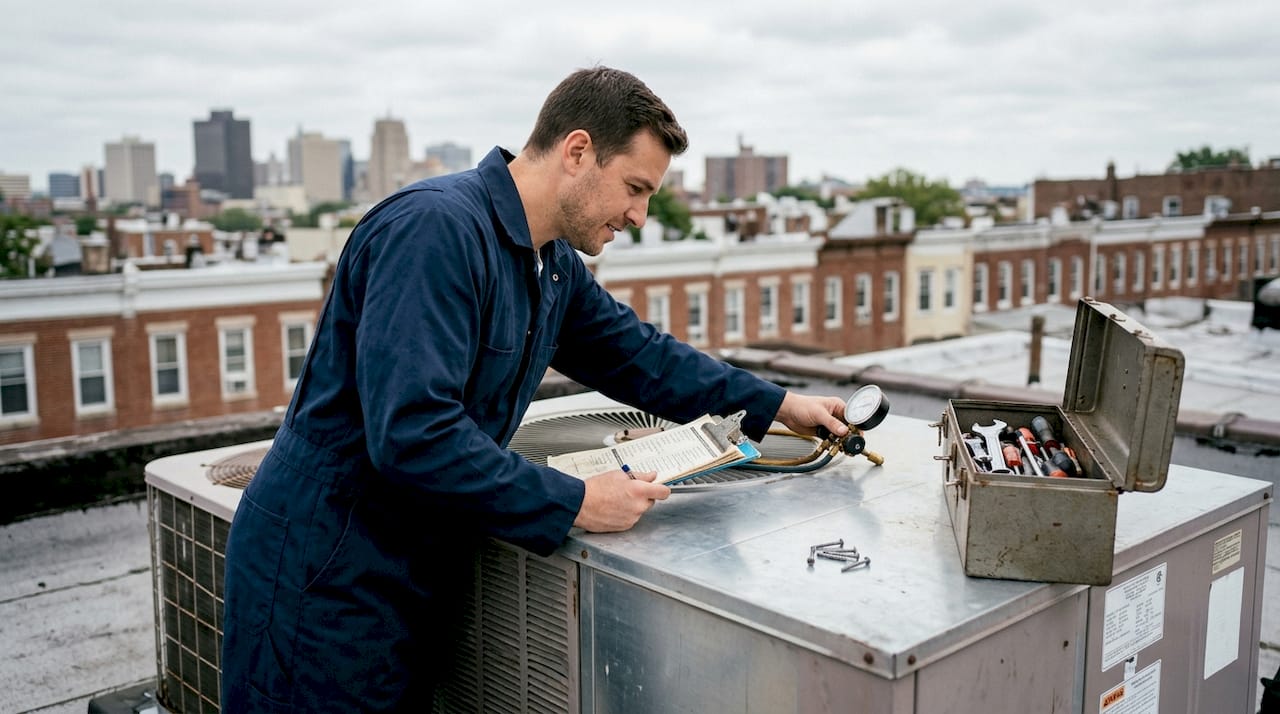
High-efficiency heat pumps are the standout option for most Newark homeowners. They move heat rather than generate it, making them far more efficient than gas furnaces in moderate climates. High-efficiency heat pumps save 20-30% on energy bills for a 2,000 sq ft Newark home, roughly $500 per year, and rebates are available to offset upfront costs.
Commercial split systems use separate indoor and outdoor units like residential splits but are built for heavier loads. They offer good zoning flexibility but require more complex installation.
Here is a quick breakdown of each option:
- VRF systems: Best for large, multi-zone homes. High efficiency, very quiet, expensive to install and service.
- Packaged rooftop units: Space-saving, durable, but often oversized and costly for residential use.
- High-efficiency heat pumps: Best overall value for Newark homes. Strong efficiency, rebate-eligible, easy to install by qualified technicians.
- Commercial split systems: Flexible zoning, but installation complexity drives up costs.
One often-overlooked option is a zoning system layered onto an existing high-efficiency setup. For multi-level Newark homes, zoning lets you control temperatures room by room without the full cost of a VRF system.
Pro Tip: When comparing systems, prioritize SEER2 ratings above 16. In Newark’s climate, that extra efficiency pays back in lower utility bills within three to five years, especially when combined with available rebates.
Comparing maintenance and operating costs
Now that you know your options, let’s see how commercial systems stack up regarding ongoing costs.
The financial gap between commercial and residential HVAC maintenance is significant and often surprises homeowners who focus only on purchase price.
| Category | Commercial HVAC | Residential HVAC |
|---|---|---|
| Service frequency | Monthly to quarterly | Once or twice per year |
| Annual maintenance cost | $1,500 to $6,000 | $150 to $500 |
| Expected system lifespan | 15 to 25 years | 15 to 20 years |
| Technician specialization | Required | Standard certified tech |
| Parts availability | Specialized, higher cost | Widely available |
Beyond the numbers in that table, there are hidden costs that catch homeowners off guard:
- Specialized repairs: Commercial components often require factory-trained technicians, which means higher labor rates and longer wait times.
- Advanced controls: Commercial systems use building management controls that need programming and periodic recalibration, adding service costs.
- System downtime: When a commercial unit needs a part, lead times can be longer than for standard residential equipment, leaving you without heat or cooling.
- Permit and inspection fees: Commercial equipment installations in Delaware often trigger additional permit requirements and inspections.
“Preventive maintenance can extend system life to 20 years while saving up to 40% on energy.”
That is a powerful return on investment, but it only holds if you actually commit to HVAC service maintenance schedules consistently. Skipping a spring or fall tune-up might save $150 today but cost you thousands in premature equipment failure. Reviewing AC installation guidelines before any new system goes in also helps you avoid setup mistakes that shorten equipment life.
For most Newark homeowners, a well-maintained high-efficiency residential system delivers SEER2 16+ efficiency and a 15 to 20-year lifespan at a fraction of the ongoing cost of commercial equipment.
Making the right choice for your home and situation
With the cost comparison in mind, let’s walk through how to choose the best system for your needs.
This is where everything comes together. Follow these steps to make a confident, well-informed decision:
- Evaluate your home’s requirements: Start with a professional load calculation. Square footage, ceiling height, insulation quality, and window placement all affect what size system you actually need.
- Check available rebates: Delaware utility programs and federal tax credits for 2026 can significantly reduce your net cost. High-efficiency heat pumps and systems with strong SEER ratings typically qualify.
- Balance upfront vs. long-term savings: A system that costs $3,000 more to install but saves $500 per year pays for itself in six years. Run the numbers before defaulting to the cheapest option.
- Consult qualified local professionals: Sizing errors and poor installation are the top causes of early system failure. Work with experienced HVAC service professionals who know Newark’s specific climate demands.
Here is a quick reference table to match common homeowner needs to the right system type:
| Your priority | Best system type | Key reason |
|---|---|---|
| Large home, multiple zones | VRF or zoned heat pump | Independent room control |
| Maximum energy savings | High-efficiency heat pump | 20-30% operating cost savings |
| Quiet operation | VRF or ductless mini-split | Low noise output |
| Lowest upfront cost | Standard split system | Simpler installation |
| Best long-term value | High-efficiency heat pump | Rebates plus low operating cost |
Delaware’s energy efficiency programs in 2026 continue to favor heat pump upgrades, so if you have been sitting on the fence, now is a practical time to act. The combination of rebates and lower operating costs makes high-efficiency heat pumps the strongest value proposition for most Newark homes.
Our take: Lessons from Newark HVAC upgrades
We have worked on a lot of Newark homes, and the pattern we see most often is homeowners who went “bigger and more commercial” thinking they were buying peace of mind, only to end up with higher maintenance bills and systems that were never the right fit for their home’s actual load.
The uncomfortable truth is that commercial-grade equipment in a residential setting rarely delivers the promised benefits. It adds complexity without proportional comfort gains. The homeowners who get the best results are the ones who invest in a properly sized, high-efficiency residential system and actually follow through on maintenance.
About 70% of the comfort complaints we hear trace back to installation quality and skipped maintenance, not the system brand or label. A mid-range heat pump installed correctly and serviced twice a year will outperform an oversized commercial unit that was rushed in and ignored. If you want reliable guidance from people who know Newark’s climate, start by finding local heating and cooling experts who will give you straight answers, not upsells.
Get expert help with your Newark HVAC upgrade
When you’re ready to put this guide into action, here’s how to get reliable support.
Putting all of this into practice is much easier when you have a trusted local team behind you. The right technician will size your system accurately, identify rebate opportunities you might miss on your own, and make sure installation is done right the first time.
At Enhanced Heating & Air Conditioning, we specialize in helping Newark homeowners find the most efficient, cost-effective solutions for their specific homes. Whether you need a full system replacement or just want a second opinion, explore our HVAC services in Newark, schedule HVAC maintenance to protect your current system, or get fast help from HVAC repair near you. We offer free consultations and transparent pricing so you always know what you’re getting.
Frequently asked questions
How often does a commercial HVAC system need maintenance?
Commercial HVAC systems require maintenance every one to three months, which is far more frequent than the once or twice per year schedule typical for residential systems. That higher frequency translates directly into higher annual service costs.
Are heat pumps a good choice for Newark, DE homes?
Yes, high-efficiency heat pumps are an excellent fit for Newark. They can save 20-30% on energy bills compared to traditional HVAC systems, and Delaware utility rebates are often available to reduce your upfront investment.
What SEER2 rating is recommended for Delaware?
A SEER2 rating of 16 or higher is recommended for Delaware homes to maximize energy savings across both the hot summer and cold winter seasons.
How do commercial and residential HVAC costs compare?
Commercial HVAC maintenance runs $1,500 to $6,000 per year, while residential maintenance typically costs $150 to $500 annually. That gap compounds significantly over the life of the system.
Recommended
- How to Schedule Hvac Maintenance and Repair Services Easily | Enhanced Heating and Air ConditioningEnhanced Heating and Air Conditioning
- HVAC Newark, DE: Expert Heating & Air Services | Enhanced Heating and Air ConditioningEnhanced Heating and Air Conditioning | HVAC Newark DE – Delaware Heating & Air
- How to Use an Hvac Maintenance Checklist in Newark De | Enhanced Heating and Air ConditioningEnhanced Heating and Air Conditioning
- How to Choose Heating and Cooling Services for Your Home | Enhanced Heating and Air ConditioningEnhanced Heating and Air Conditioning