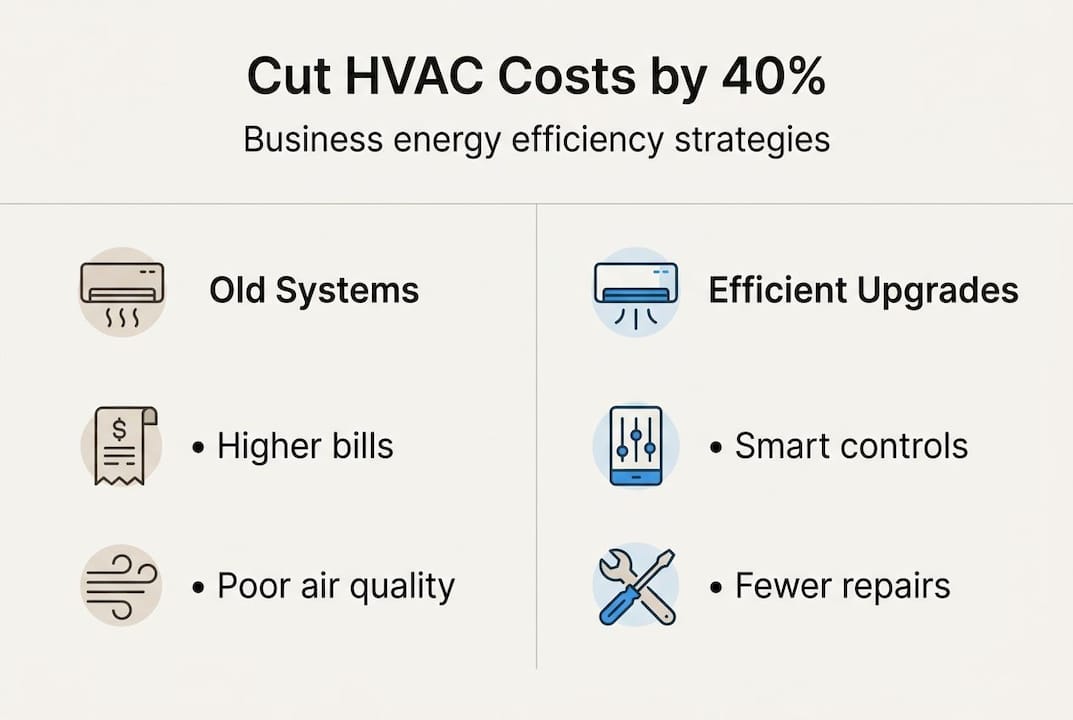
HVAC for businesses: Cut energy costs by 40%
Most Newark, DE business owners don’t realize their HVAC system is quietly draining their budget every single month. Outdated or neglected systems can push energy bills through the roof, create uncomfortable work environments, and trigger expensive emergency repairs at the worst possible times. HVAC, which stands for heating, ventilation, and air conditioning, is far more than a temperature dial on the wall. It shapes how your employees feel at work, how customers perceive your space, and how lean your operating costs actually run. This guide breaks down what HVAC really does for your business, how to choose the right system, and how to keep it running at peak performance.
Table of Contents
- Why HVAC is a foundational asset for every business
- Energy efficiency: Reducing costs and boosting sustainability
- Choosing the right HVAC system for your Newark, DE business
- Ongoing maintenance: Protecting your investment and comfort
- A Newark expert’s take: What businesses often get wrong about HVAC
- Partnering with trusted local pros: Your next steps
- Frequently asked questions
Key Takeaways
| Point | Details |
|---|---|
| HVAC boosts business performance | Climate control directly affects comfort, air quality, and productivity in commercial settings. |
| Efficiency equals savings | Investing in newer, high-efficiency systems and routine maintenance can cut energy use and costs. |
| Choose solutions tailored to you | The best HVAC setup matches your building’s size, usage, and local climate for maximum impact. |
| Ongoing maintenance prevents problems | Regular inspections and scheduled care protect your investment and avoid unexpected disruptions. |
Why HVAC is a foundational asset for every business
Think of your HVAC system the way you think about your internet connection. When it works, nobody notices. When it fails, everything stops. That’s the quiet power HVAC holds over your daily operations.
HVAC systems control three core functions inside your commercial space:
- Heating: Keeps your space warm during Delaware’s cold winters, protecting both people and equipment.
- Ventilation: Circulates fresh air, removes stale air, and filters out pollutants, allergens, and airborne contaminants.
- Air conditioning: Maintains cool, comfortable temperatures during the hot and humid Newark summers.
But the impact goes well beyond comfort. Proper HVAC can impact productivity and lower absenteeism, which means your team works better and misses fewer days when the indoor environment is right. Studies consistently show that a well-controlled indoor climate can lift staff productivity by up to 10%. That’s a meaningful number when you multiply it across your entire workforce.
Poor air quality is another hidden cost. When ventilation is weak, carbon dioxide levels rise, air feels stale, and people lose focus. Headaches, fatigue, and respiratory irritation become regular complaints. These aren’t just comfort issues; they translate directly into lost hours and higher turnover.
From a customer experience standpoint, walking into a sweltering retail space or a freezing office lobby sends an immediate negative signal. People make fast judgments. A comfortable, well-conditioned environment tells customers you run a professional, well-managed operation.
Reliable HVAC also protects your equipment. Servers, refrigeration units, and sensitive machinery all have temperature tolerances. Letting your climate control slip can damage assets worth far more than the cost of a maintenance visit.
If you want to compare HVAC services available in Newark, it helps to first understand what your business actually needs from a system before making any decisions. Modern HVAC field service solutions also make scheduling and tracking maintenance far simpler than it used to be.
Energy efficiency: Reducing costs and boosting sustainability
Energy costs are one of the most controllable line items in your operating budget, yet most businesses treat them as fixed. They’re not.
In commercial spaces, energy bills can represent 40-60% of operating expenses. A large portion of that goes directly to heating and cooling. If your system is more than 10-15 years old, it’s almost certainly burning more energy than it needs to.
Here’s a quick comparison of older versus modern HVAC performance:
| Feature | Older system (10+ years) | Modern high-efficiency system |
|---|---|---|
| SEER rating | 8-10 | 16-25+ |
| Annual energy cost | Higher baseline | 20-40% lower |
| Maintenance frequency | Reactive, as needed | Planned, preventive |
| Rebate eligibility | Rarely | Often qualifies |
| Lifespan remaining | Limited | 15-20+ years |
SEER stands for Seasonal Energy Efficiency Ratio. It measures how efficiently an air conditioning system uses electricity over a cooling season. The higher the SEER rating, the less energy the system burns to do the same job. You can learn more about AC efficiency ratings to understand what score makes sense for your building size and usage.
Upgrading to high-efficiency HVAC can reduce energy costs by 20-40%, which is a significant return on investment for most commercial operations. Add in potential rebates from Delaware energy programs, and the payback period shortens considerably.

Automation plays a big role here too. Smart thermostats and building management systems let you schedule temperature changes based on occupancy, so you’re not cooling an empty office at full power on a Saturday afternoon.
Pro Tip: Schedule HVAC maintenance at least twice a year, ideally before summer and before winter. Catching a dirty coil or a refrigerant issue early can prevent a 30% spike in energy consumption that sneaks up on you over months.
Consistent preventive HVAC maintenance is the single most cost-effective habit a business owner can build around their climate control system.
Choosing the right HVAC system for your Newark, DE business
Not every system fits every building. Choosing the wrong setup is one of the most expensive mistakes a business owner can make, and it’s more common than you’d think.
Here are the main system types available for commercial use:
| System type | Best for | Key advantage |
|---|---|---|
| Split system | Small to mid-size offices | Flexible, cost-effective |
| Packaged unit | Rooftop or compact spaces | All-in-one, saves indoor space |
| Heat pump | Mild to moderate climates | Heats and cools in one unit |
| Ductless mini-split | Older buildings, additions | No ductwork needed |
Factors like building size, insulation, and use patterns all affect which HVAC system will serve you best. A retail shop with high foot traffic and lots of glass windows has completely different needs than a warehouse or a medical office.
Here’s a practical process for narrowing down your options:
- Measure your space accurately. Square footage is the starting point, but ceiling height and layout matter just as much.
- Assess your insulation. Poor insulation forces your system to work harder. Fix insulation gaps before sizing a new unit.
- Map your usage patterns. Do you run 24/7 or only during business hours? Occupancy schedules shape system requirements.
- Consider your local climate. Newark, DE gets hot, humid summers and cold winters. You need a system built for both extremes.
- Review AC installation guidelines to understand what’s involved before committing to a unit.
If you’re weighing options, comparing a heat pump vs. HVAC system is a smart place to start. Heat pumps are increasingly popular in Delaware’s climate because they handle both heating and cooling efficiently.
Pro Tip: Always factor in lifecycle costs, not just the purchase price. A cheaper unit that needs replacement in 8 years costs more than a quality system that runs reliably for 20. Use HVAC asset management tips to build a full cost picture before you decide.
Working with a credentialed local contractor who knows Newark’s building codes and climate patterns is non-negotiable. Generic national chains rarely understand the local nuances that affect system performance here.
Ongoing maintenance: Protecting your investment and comfort
Buying a great HVAC system and ignoring it afterward is like buying a new car and never changing the oil. The investment deteriorates fast.
Routine inspections catch issues before they become costly breakdowns. A refrigerant leak caught during a scheduled visit costs a fraction of what an emergency compressor replacement runs. The math is simple.
Here’s what a solid maintenance routine covers:
- Filter replacement: Dirty filters restrict airflow, force the system to work harder, and degrade air quality. Change them every 1-3 months depending on usage.
- Coil cleaning: Evaporator and condenser coils collect grime over time, reducing efficiency significantly.
- Electrical inspections: Loose connections and worn components are fire hazards and efficiency killers.
- Refrigerant checks: Low refrigerant reduces cooling capacity and damages the compressor over time.
- Duct inspection: Leaky ducts can waste 20-30% of conditioned air before it ever reaches your space.
“Planned maintenance agreements give business owners predictable costs and priority service, which is far better than scrambling for emergency help in the middle of a July heat wave.”
If you start noticing uneven temperatures, strange noises, or rising energy bills, it’s time to diagnose AC problems before they escalate. Waiting rarely saves money.
Documentation matters too. Keeping records of every service visit, repair, and parts replacement gives you data to make smarter decisions about when to repair versus replace. Good commercial HVAC maintenance providers will track this for you.
Pro Tip: Use maintenance reporting tools to track your system’s performance trends over time. Spotting a gradual efficiency decline early is far less painful than reacting to a full system failure.
A Newark expert’s take: What businesses often get wrong about HVAC
After working with commercial clients across Newark, DE, the pattern we see most often is this: business owners treat HVAC as a reactive expense rather than a managed asset. They call us when something breaks. Rarely do they call to prevent the break.
The businesses that spend the least on HVAC over time are the ones that invest in planned care from the start. They schedule visits, ask questions, and track their system’s performance. The ones that spend the most are the ones calling for emergency HVAC service repair in August when every technician in the region is already booked.
Newark’s climate also creates a specific challenge. The combination of humid summers and cold winters means your system cycles hard in both directions. A system sized or configured for a milder climate will underperform here. One-size-fits-all solutions, often pitched by out-of-area contractors, rarely account for this.
The lowest bid is almost never the best value. We’ve seen businesses save a few hundred dollars upfront only to spend thousands more within two years on repairs that a quality installation would have avoided. Local expertise, proper credentials, and a real maintenance relationship are worth paying for.
Partnering with trusted local pros: Your next steps
Understanding HVAC’s role in your business is the first step. Acting on that knowledge is where the real savings and comfort gains happen.
At Enhanced Heating & Air Conditioning, we work specifically with Newark, DE businesses to design, install, and maintain climate control systems that fit your space, your budget, and your goals. Whether you need HVAC services in Newark for a new installation, fast HVAC repairs when something goes wrong, or a structured preventive HVAC maintenance plan to protect your investment year-round, we’re ready to help. Reach out today for a free consultation and let’s build a plan that keeps your business comfortable and your energy costs under control.
Frequently asked questions
How often should a business schedule HVAC maintenance?
Most experts recommend biannual commercial maintenance to prevent costly breakdowns and keep efficiency high. Scheduling once before summer and once before winter covers both peak demand seasons.
What factors affect the cost of HVAC operations for businesses?
Major cost drivers include equipment age, system efficiency, insulation quality, building size, and usage patterns. Energy bills represent 40-60% of operating expenses in many commercial spaces, making HVAC one of the highest-impact areas to optimize.
Are there benefits to choosing energy-efficient HVAC systems?
Absolutely. High-efficiency systems reduce energy costs by 20-40% and often qualify for rebates or local incentive programs, shortening the payback period significantly.
Why is indoor air quality important for businesses?
Good air quality lowers absenteeism and keeps employees focused and productive. Poor ventilation raises CO2 levels, which causes fatigue and reduces cognitive performance across your team.
How do I choose the right HVAC contractor for my business?
Look for a provider with local experience, proper credentials, and a proven maintenance track record. Credentialed local contractors familiar with Newark’s building codes and climate will deliver better long-term results than a generic national service.
Recommended
- Heat Pump Vs Hvac: Which Is Cheaper in Newark De? | Enhanced Heating and Air ConditioningEnhanced Heating and Air Conditioning
- Energy-Saving HVAC: Benefits & Savings | Enhanced HeatingEnhanced Heating and Air Conditioning
- How to Estimate Hvac Replacement Service Costs | Enhanced Heating and Air ConditioningEnhanced Heating and Air Conditioning
- How Often Should I Schedule Hvac Service Maintenance? | Enhanced Heating and Air ConditioningEnhanced Heating and Air Conditioning
- Role of Automation in Asset Management – Transforming HVAC Efficiency