Practical air conditioning tips every Newark homeowner needs
Summer in Newark, DE hits harder than most people expect. Humidity climbs, temperatures push into the 90s, and your central AC runs almost nonstop trying to keep up. The result? Utility bills that feel more painful than the heat itself. The good news is that most Newark homeowners can meaningfully cut their cooling costs and improve indoor comfort without replacing their entire system. These practical, expert-backed tips will help you get the most out of your AC all season long.
Table of Contents
- Choose the smartest thermostat settings
- Keep air filters and coils clean
- Seal air leaks and weatherize your home
- Tap into local rebates and incentives for upgrades
- What if your AC still isn’t cooling right?
- Our honest take on summer AC efficiency
- Ready to get your Newark home summer-ready?
- Frequently asked questions
Key Takeaways
| Point | Details |
|---|---|
| Smart thermostat settings | Adjusting your thermostat by just a few degrees can yield big savings without sacrificing comfort. |
| Regular filter checks | Changing air filters monthly ensures better efficiency, air quality, and lower repair risk. |
| Seal those leaks | Weatherizing and sealing air leaks reduces cooling demands and keeps rooms comfortable. |
| Local rebates help upgrade | Rebates from Energize Delaware make it affordable to improve efficiency with new equipment or weatherization. |
| Know when to ask for help | If humidity or cooling issues persist, enlist an HVAC pro—small changes fix most problems, but some need expert attention. |
Choose the smartest thermostat settings
To make your AC work smarter, not harder, the first step is setting your thermostat optimally. Most people either set it way too low hoping for faster cooling, or they forget to adjust it when leaving for work. Both habits quietly drain your wallet every month.
DOE guidance on home cooling recommends using a reasonable summer setpoint of 75°F to 78°F when you’re home to reduce energy use without sacrificing comfort. That range keeps most people comfortable while giving your system a realistic target to maintain. When you head out for the day, raise the setpoint by about 7°F. That one adjustment can save you noticeably on your monthly bill without any sacrifice to comfort when you return.
Here’s what many Newark homeowners get wrong:
- Setting the thermostat to 65°F thinking it will cool the house faster. It won’t. Your AC cools at the same rate regardless. It just runs longer, costing you more.
- Turning the system completely off during the day. When you return to an 85°F house, your AC has to work overtime to recover, often creating uncomfortable humidity spikes.
- Ignoring the “schedule” feature on their existing thermostat. Many standard digital thermostats already have this built in.
- Overlooking the thermostat settings guide that can clarify ideal setpoints season by season.
A programmable or smart thermostat takes the guesswork out entirely. You set a schedule once, and the system adjusts itself automatically. Some smart thermostats even learn your routines and adapt over time, making spring AC settings transitions seamless without any manual input.
Pro Tip: Resist the urge to crank the thermostat down dramatically when you first get home. Let the system ramp up steadily. Drastic swings force the compressor to work harder and can increase wear on the unit over time.
The biggest thermostat myth to bust: A lower setpoint does not equal faster cooling. Your compressor runs at one speed (unless you have a variable-speed system), so the only thing changing the temperature dramatically does is extend the runtime and the bill.
Keep air filters and coils clean
Optimal thermostat settings are just part of the equation. Clean airflow pathways matter just as much, and this is the maintenance step most Newark homeowners skip or simply forget.
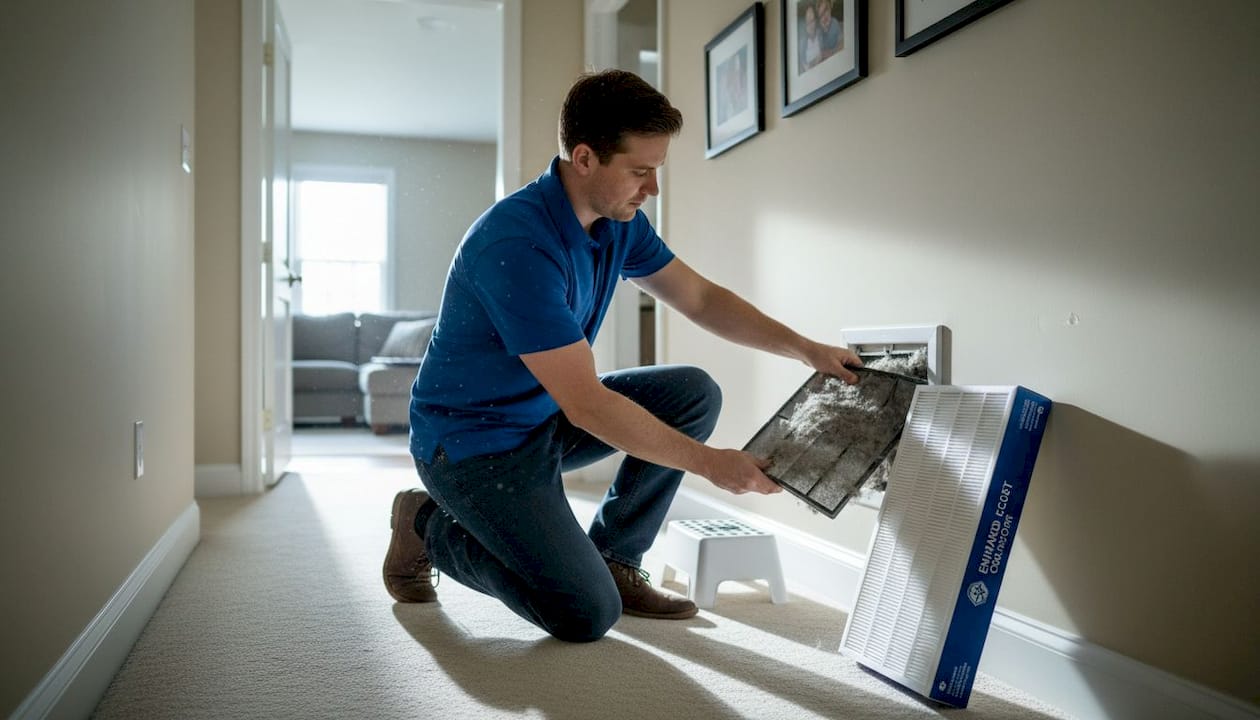
A clogged filter forces your AC to pull air through a restricted surface. Your blower works harder, airflow drops, and your evaporator coil starts to get too cold without enough warm air passing over it. The result is reduced cooling power, higher energy bills by 5% to 15%, and in the worst cases, a frozen coil that shuts your system down entirely.
Follow this simple maintenance checklist:
- Check your air filter every single month during cooling season. In July and August, some Newark homes need changes every three weeks if they have pets or dusty conditions.
- Replace 1-inch filters every 30 days. Thicker 4-inch media filters can often last 90 days, but check the manufacturer’s guidance.
- Look at your filter maintenance guide to match the right MERV rating (Minimum Efficiency Reporting Value) to your system. A MERV that’s too high can actually restrict airflow and cause the same problems as a dirty filter.
- Schedule an annual coil cleaning. Your evaporator coil (inside the air handler) and condenser coil (outside unit) both collect dirt and grime. A dirty coil can’t transfer heat efficiently, which means longer run times and higher bills.
“Keeping airflow unobstructed is essential for both energy savings and your family’s comfort.” That’s not just a catchphrase. It’s the single most cost-effective maintenance habit you can build.
If you’re dealing with persistent issues despite regular filter changes, check the AC troubleshooting steps that walk you through diagnosing common airflow problems before calling a technician.
Pro Tip: Set a recurring phone reminder for the first Saturday of every month. Label it “AC filter check.” Takes five minutes. Costs almost nothing. And it can add years to your system’s life.
Seal air leaks and weatherize your home
Proper airflow helps your AC run better, but lost cool air from leaks completely undermines those gains. If your house leaks like a sieve, no thermostat setting or clean filter will make it comfortable for long.
Uncontrolled heat gain from air leaks forces your AC to fight a battle it can’t win. Warm, humid outside air sneaks in through gaps around windows, doors, attic hatches, electrical outlets, and crawlspace openings. Your system runs longer trying to compensate, and your energy bills reflect every minute of that extra runtime.
DOE recommends weatherizing your home and minimizing uncontrolled air leakage as one of the most effective ways to keep your home cool efficiently. Here’s how to do it systematically:
- Do a visual walkthrough. Walk around your home on a breezy day and feel for drafts near windows, exterior doors, and wall penetrations where pipes or wires enter the house.
- Check the attic hatch. This is one of the biggest and most overlooked air leak points in Newark homes. An unsealed attic hatch lets hot attic air pour directly into your living space.
- Caulk window and door frames. Use a paintable silicone caulk for gaps under 1/4 inch. For larger gaps, use foam backer rod first, then caulk over it.
- Weatherstrip exterior doors. A door you can see daylight around is losing serious amounts of conditioned air every day. Door sweeps and compression weatherstripping are inexpensive and easy to install.
- Insulate as needed. Once air leaks are sealed, check your attic insulation levels. Newark homes should target R-49 to R-60 for attic insulation based on Delaware’s climate zone.
Understanding how HVAC systems work helps put this in perspective. Your AC is only one piece of the comfort equation. The building envelope (walls, roof, windows, and floors) determines how much work your AC actually has to do.
Pro Tip: Weatherization pays dividends year-round. The same work that keeps cool air in during summer keeps warm air in during winter. It’s one of the highest-return investments a Newark homeowner can make.
Tap into local rebates and incentives for upgrades
Beyond DIY fixes, some improvements call for a bigger investment. But real financial help is available right here in Delaware, and many Newark homeowners don’t even know it exists.
Energize Delaware runs a program called Home Performance with ENERGY STAR that provides whole-house assessments and rebates for qualifying energy-efficient improvements. Participating homeowners typically see average energy savings of 20% or more per year after completing recommended upgrades.
Here’s a look at what’s typically covered:
| Upgrade type | Potential rebate | Efficiency requirement |
|---|---|---|
| Air sealing and insulation | Up to several hundred dollars | Based on verified blower door test results |
| Duct sealing | Included in whole-home programs | Verified reduction in duct leakage |
| Heat pump installation | Significant rebates available | Minimum SEER/HSPF ratings required |
| Smart thermostat | Rebates available through utilities | ENERGY STAR certified models |
| Central AC replacement | Rebates for high-efficiency units | SEER 16+ in many programs |
To qualify, you typically need to start with a home energy assessment from a certified contractor. That assessment identifies the biggest energy losses in your home and creates a priority list of improvements. You only pay for the improvements you choose, and the rebates come off the final cost.
Some key eligible improvements to look into:
- Air sealing throughout the building envelope
- Attic and basement insulation upgrades
- Duct sealing and insulation in unconditioned spaces
- Heat pump installation replacing older gas or electric systems
- Smart thermostat upgrades paired with behavioral changes
Before scheduling any major repairs, it’s smart to review current HVAC repair costs so you can compare the value of repair vs. upgrade with available incentives factored in.
What if your AC still isn’t cooling right?
Sometimes, even with all best practices followed faithfully, cooling problems persist. Here’s what to try next before assuming you need a full replacement.
Common culprits when your AC runs constantly but can’t keep up include dirty or blocked filters (back to square one), a frozen evaporator coil, an incorrectly sized system, or refrigerant issues. If your rooms feel clammy even with the AC running, that’s a dehumidification problem that often points to airflow issues, wrong unit sizing, or refrigerant charge problems that prevent adequate dehumidification during normal run cycles.
| Problem | DIY fix | When to call a pro |
|---|---|---|
| Warm air from vents | Check filter and thermostat settings | Refrigerant leak, compressor issue |
| Ice on the AC unit | Turn off, let thaw, replace filter | Coil damage, refrigerant problem |
| High humidity indoors | Check filter, ensure vents are open | Wrong unit size, duct leakage |
| AC won’t turn on | Check breaker and thermostat batteries | Electrical fault, failed capacitor |
| Weak airflow from vents | Check filter and open all registers | Collapsed duct, blower motor issue |
Start with the DIY checks. You’d be surprised how often a tripped breaker or a forgotten dirty filter is the real culprit. If you’ve gone through the basics and still have problems, read up on why your AC isn’t cooling for more detailed guidance.
If basic fixes don’t resolve the issue, it’s time for professional AC diagnostics. A certified technician can check refrigerant levels, test electrical components, measure airflow through the duct system, and verify that your unit is properly sized for your home. Reviewing common AC problems ahead of your service call helps you describe symptoms accurately, which speeds up diagnosis.
Our honest take on summer AC efficiency
Here’s something most articles won’t tell you: the tips above work best as a system, not as individual fixes. We’ve seen Newark homeowners replace their entire AC unit while leaving a leaky attic, dirty coils, and a thermostat set to 68°F. Their new system struggled just as much as the old one.
The order matters too. Fix the building envelope before upgrading equipment. Seal leaks and improve insulation first. Then, with reduced cooling load, you might find your existing system actually performs well enough. Or, if you do need new equipment, you might qualify for a smaller, less expensive unit because the house now requires less capacity.
We also want to push back on the idea that comfort is purely about temperature. Humidity is the real villain in Delaware summers. An AC that cools to 74°F but leaves the air at 65% relative humidity will feel far less comfortable than one that maintains 76°F at 50% humidity. If clammy is your complaint, focus on airflow and proper sizing before chasing a lower thermostat setpoint.
The homeowners who see the biggest improvements are the ones who treat their AC system as part of a whole-house comfort plan, not just a box that blows cold air.
Ready to get your Newark home summer-ready?
If you’ve worked through these tips and still have questions about your system’s performance, our team at Enhanced Heating & Air Conditioning is here to help. We serve Newark and the surrounding Delaware area with honest assessments, transparent pricing, and BBB-accredited service you can trust.

Whether you need a seasonal tune-up, a filter inspection, or a full system evaluation, we offer free consultations to get you started without any pressure. Our technicians know Newark homes inside and out, from older split-level builds to newer townhomes, and we’ll give you a straight answer about what your system actually needs. Reach out to the Enhanced Heating & Air Conditioning team today and let’s get your home cooling efficiently before the hottest weeks of summer arrive.
Frequently asked questions
How often should I change my AC filter during summer in Newark, DE?
You should check your filter monthly during cooling season and replace it as soon as it looks gray or clogged, which in many Newark homes means every three to four weeks during peak summer heat.
What’s the best temperature to set my thermostat for comfort and savings?
A summer setpoint of 75°F to 78°F balances efficiency and comfort well, and raising it 7°F when you leave the house can reduce energy use without sacrificing comfort on your return.
Are there any local rebates for energy-efficient AC upgrades in Delaware?
Yes, Energize Delaware offers rebates for qualifying upgrades including air sealing, duct sealing, heat pump installation, and smart thermostats through the Home Performance with ENERGY STAR program.
What if my AC runs a lot but doesn’t properly remove humidity?
Persistent humidity despite constant AC runtime often points to airflow issues, wrong unit sizing, or a refrigerant problem; start with filter and coil checks, and if those don’t resolve it, schedule professional diagnostics to identify the root cause.
Recommended
- AC Troubleshooting Steps Every Newark Homeowner Needs
- How to install central air in Newark, DE: a homeowner’s guideEnhanced Heating and Air Conditioning
- How to Choose a Window Air Conditioning Installation Service | Enhanced Heating and Air ConditioningEnhanced Heating and Air Conditioning
- Blog | Enhanced Heating And Air Conditioning