
Why Proper HVAC Sizing Maximizes Comfort and Savings
Most homeowners in Newark, DE assume that a bigger HVAC system means better comfort. That assumption is costing people real money. Oversized and undersized systems are behind most complaints we hear: rooms that never quite reach the right temperature, energy bills that seem unreasonably high, and equipment that wears out years ahead of schedule. Proper HVAC sizing is not about picking a number based on square footage alone. It is a precise calculation that accounts for your home’s unique characteristics and Newark’s specific climate. This guide breaks down how sizing works, why it matters, and exactly what you can do to get it right.
Table of Contents
- What is proper HVAC sizing?
- Why improper HVAC sizing causes problems
- How Newark, DE climate impacts your HVAC sizing
- Ensuring accurate HVAC sizing: Homeowner checklist
- The uncomfortable truth: Most homes get HVAC sizing wrong
- Connect with Newark, DE HVAC experts for proper sizing
- Frequently asked questions
Key Takeaways
| Point | Details |
|---|---|
| Accurate sizing prevents waste | Right-sized HVAC systems save money, boost comfort, and avoid premature breakdowns. |
| Climate matters in sizing | Newark, DE’s mixed-humid climate demands precise load calculations for both extreme heat and cold. |
| Manual J is essential | A professional Manual J load calculation is the foundation of correct HVAC sizing. |
| Ask smart questions | Asking for detailed load calculations and checking contractor methods is crucial for proper sizing. |
What is proper HVAC sizing?
Sizing an HVAC system is not guesswork. It is a structured engineering process built around one core question: how much heating and cooling does your specific home actually need? The answer comes from a Manual J load calculation, which is the industry standard developed by the Air Conditioning Contractors of America (ACCA). Manual J looks at your home as a complete thermal system, not just a box with square footage.
The calculation pulls in a wide range of variables. Your local climate zone, the amount and type of insulation in your walls and attic, the size and orientation of your windows, how airtight your home is, how many people live there, and even the heat generated by appliances all factor in. Miss one of these, and the resulting system size could be off by a full ton or more.
For Newark, DE, the ASHRAE design temperatures sit at approximately 14°F for heating and 91°F dry-bulb with 75°F wet-bulb for cooling. That combination of cold winters and humid summers creates a demanding sizing environment. A system sized for a milder climate would struggle here.
Here is a summary of the key Manual J variables and how they apply locally:
| Variable | What it measures | Newark, DE relevance |
|---|---|---|
| Climate zone | Outdoor design temperatures | IECC Zone 4A, mixed-humid |
| Insulation levels | Heat gain/loss through walls and roof | Older Newark homes often under-insulated |
| Window area and direction | Solar heat gain in summer | South/west exposure increases cooling load |
| Infiltration rate | Air leakage through the building envelope | Older construction = higher leakage |
| Occupancy | Internal heat from people | Affects cooling load directly |
| Internal gains | Heat from appliances and lighting | Often underestimated in sizing |
Key factors your contractor must evaluate before sizing your system:
- Square footage is a starting point, not a final answer
- Ceiling height affects total air volume to condition
- Window orientation determines solar heat gain
- Insulation R-values define how fast your home loses or gains heat
- Duct condition affects how efficiently conditioned air reaches each room
For Newark, DE HVAC climate insights and how they apply to your specific home, the details matter far more than most homeowners realize. When you are choosing heating and cooling services, always ask whether a full Manual J calculation is included.
Why improper HVAC sizing causes problems
Now that you know what goes into sizing, let’s see what happens when a system is not sized correctly. The consequences are not minor. They show up in your comfort, your utility bills, and your system’s lifespan.
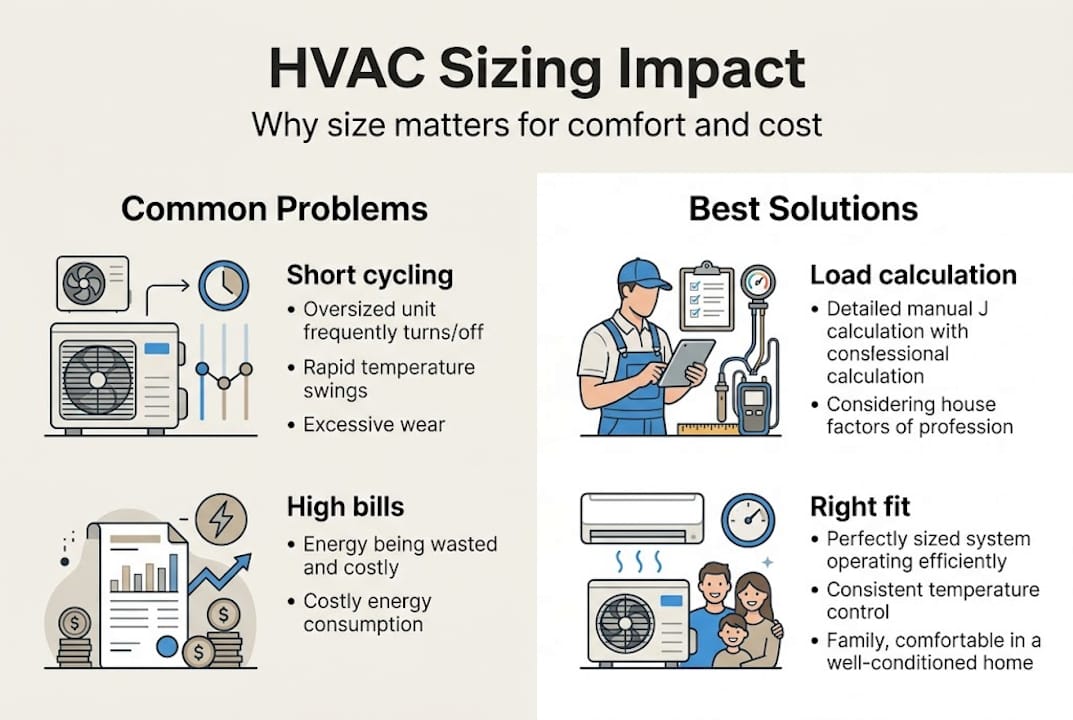
Oversized systems are the more common mistake. A unit that is too large heats or cools the space quickly, then shuts off before completing a full cycle. This is called short-cycling. It sounds efficient, but it is the opposite. Short-cycling means the system never runs long enough to properly dehumidify the air in summer, leaving your home feeling clammy even at the right temperature. It also causes excessive wear on the compressor and other components because frequent starts and stops are harder on equipment than steady operation.

Undersized systems have the opposite problem. They run almost constantly trying to meet demand and still fall short on the hottest and coldest days. Your home never quite reaches the set temperature, your energy bills climb, and the equipment ages faster from the constant strain.
Here is a direct comparison:
| System size | Summer comfort | Winter comfort | Energy use | Equipment wear |
|---|---|---|---|---|
| Oversized | Clammy, uneven | Uneven temps | High (short-cycling) | High (frequent starts) |
| Undersized | Never cool enough | Never warm enough | Very high (constant run) | Very high (overworked) |
| Properly sized | Consistent, dry | Even warmth | Optimized | Normal |
Here is the sequence of problems that follows an oversized installation:
- System cools or heats the space too quickly
- Thermostat triggers a shutdown before a full cycle completes
- Humidity stays high in summer because dehumidification is incomplete
- Homeowner lowers the thermostat trying to feel comfortable
- Bills rise, comfort stays poor, and the system wears out early
Some contractors suggest adding a “safety factor” to the Manual J result, bumping up system size just in case. This is a mistake. Variable-speed equipment can handle minor oversizing, but no technology fixes gross errors. Manual J is already precise for Newark, DE conditions.
Pro Tip: If a contractor quotes you a system size without mentioning a load calculation, that is a red flag. Check the HVAC service cost breakdown to understand what a proper sizing process should include.
How Newark, DE climate impacts your HVAC sizing
Next, let’s connect these sizing concepts directly to the Newark, DE climate and why it matters locally. Newark sits in IECC Climate Zone 4A, which means mixed-humid conditions. That combination is one of the more demanding environments for HVAC systems because you need real heating capacity in winter and real dehumidification capacity in summer.
The ASHRAE design temperatures for Newark are approximately 14°F for heating and 91°F dry-bulb with 75°F wet-bulb for cooling. These numbers define the worst-case conditions your system must handle. Your Manual J calculation is built around these extremes.
Key Newark-specific factors that shape your load calculation:
- Humid summers mean dehumidification is as important as temperature control. An oversized system that short-cycles will fail at this.
- Cold winters push heating loads high, especially in older homes with limited insulation.
- South and west-facing windows dramatically increase cooling loads in summer. A room with large west-facing windows can need significantly more cooling capacity than an identical room facing north.
- Older housing stock in Newark often has higher infiltration rates, meaning more outdoor air leaks in and must be conditioned.
- Shade from mature trees can reduce cooling loads, but only if properly accounted for in the calculation.
Newark’s climate demands a system that handles both humidity and temperature extremes, not just one or the other.
One factor homeowners frequently overlook: renovations change your load. New windows, added insulation, a finished basement, or even a room addition all shift the thermal balance of your home. After any significant renovation, your sizing calculation needs to be revisited. Your local HVAC service options should include this recalculation as a standard step.
Pro Tip: If you have recently upgraded windows or added insulation, ask your contractor to run a new load calculation before any air conditioning installation. Your old system size may no longer apply.
Ensuring accurate HVAC sizing: Homeowner checklist
With local context in mind, here is how you can make sure your HVAC is properly sized when working with professionals. You do not need to run the calculations yourself. You do need to ask the right questions and recognize the warning signs of a contractor cutting corners.
Follow this checklist when planning an HVAC replacement or new installation:
- Request a written Manual J calculation. This is non-negotiable. If a contractor will not provide one, find someone who will.
- Ask about Manual S for equipment selection. Manual S uses real-world performance data to select equipment that matches your calculated load under actual Newark, DE conditions, not just nameplate ratings.
- Confirm duct design is included. Manual D governs duct sizing. Poorly designed ducts undermine even a perfectly sized system by creating pressure imbalances and airflow losses.
- Provide accurate home information. Square footage, ceiling heights, window sizes and directions, insulation levels, and any recent renovations all feed the calculation.
- Ask how renovations are handled. A good contractor will flag when a recalculation is needed.
Red flags to watch for:
- Contractor sizes the system based on square footage alone with no further questions
- No mention of Manual J, Manual S, or duct design
- System size is identical to what you had before without any analysis
- Quote is delivered within minutes of a brief walkthrough
“High window south and west exposure increases cooling load significantly; poor duct design amplifies sizing errors through velocity and friction losses; any renovation requires a full recalculation.”
Your ductwork is part of the sizing equation. A properly sized unit connected to undersized or leaky ducts will perform like an undersized unit. Proper HVAC maintenance steps include checking duct integrity as part of any sizing review. When comparing contractors, HVAC service pricing should reflect the time and expertise required for a thorough load calculation, not just a quick estimate.
The uncomfortable truth: Most homes get HVAC sizing wrong
So what does real-world experience tell us about HVAC sizing, especially in Newark, DE? Here is the honest answer: most systems installed in this area were never properly sized. Not because contractors are incompetent, but because proper Manual J calculations take time, require detailed homeowner input, and are harder to explain to a customer than a simple square footage rule.
Quick quotes win jobs. Thorough calculations win long-term customer satisfaction. Those are not always the same thing.
The hidden forces behind most sizing mistakes are humidity and window direction. Contractors who rely on rules of thumb almost never account for a home’s specific window orientation or the actual moisture load of a Newark summer. These two factors alone can shift a load calculation by a full ton in either direction.
Manual S equipment selection paired with Manual D duct design is what separates a professional installation from a replacement job. Variable-speed systems help absorb minor sizing errors, but they are not a substitute for precision.
Our advice: insist that your contractor walks through your home thoroughly and asks detailed questions before quoting a system size. If they skip that step, the sizing will be wrong. For local service selection tips that help you find contractors who do this right, knowing what to look for is your best protection.
Connect with Newark, DE HVAC experts for proper sizing
Ready to put your new HVAC sizing knowledge to work and avoid costly errors?

At Enhanced Heating & Air Conditioning, we run full Manual J load calculations for every Newark, DE home we work with. We do not guess. We measure, calculate, and select equipment using real performance data for your specific conditions. Whether you are replacing an aging system, planning a new installation, or just want to know if your current setup is right-sized, we are here to help. Learn about best installation location advice and explore our maintenance service details. Contact us today to schedule a free consultation and see all our Newark, DE HVAC services.
Frequently asked questions
What is Manual J and why does it matter for HVAC sizing?
Manual J is the ACCA-developed method for calculating a home’s exact thermal load, so your HVAC system is matched to real heating and cooling needs rather than a rough estimate. Without it, your system is likely the wrong size.
How does climate in Newark, DE affect my HVAC sizing?
Newark’s IECC Zone 4A climate combines 14°F winter design temperatures with humid 91°F summers, meaning your system must handle both extreme cold and significant moisture loads. A system sized for a milder region will underperform here.
What happens if my HVAC system is oversized?
An oversized system short-cycles, which means it shuts off before completing a full run, leaving humidity high and comfort low. Variable-speed equipment can soften minor oversizing but cannot fix a system that is grossly too large.
Should I recalculate HVAC sizing after home renovations?
Yes. Window upgrades, added insulation, or finished spaces all change your home’s thermal load. South and west window exposure alone can shift your cooling needs significantly, so a new load calculation is essential after any major renovation.
Recommended
- Home Thermostat Settings: Comfort & Savings Guide (2025)Enhanced Heating and Air Conditioning
- HVAC Technician Demand: Future Trends | Enhanced HeatingEnhanced Heating and Air Conditioning
- HVAC Replacement: Questions to Ask Your Contractor in 2025Enhanced Heating and Air Conditioning
- How Often Should I Schedule Hvac Service Maintenance? | Enhanced Heating and Air ConditioningEnhanced Heating and Air Conditioning
- What is HVAC zoning? Improve comfort & cut costs
- Why upgrade your HVAC system? Enhance comfort and efficiency