

Most AC service calls in Newark, DE trace back to problems that were completely avoidable. A dirty filter here, an oversized unit there, or a system installed without proper sizing calculations adds up to hundreds of dollars in unnecessary repairs every single summer. The good news is that a little foundational knowledge goes a long way. This guide walks you through how central air systems work, what efficiency ratings actually mean, which maintenance tasks you can handle yourself, and how to make sure your system is built right from the start.
Table of Contents
- What makes up a central air conditioning system
- How efficiency ratings work: SEER2 and beyond
- Common AC problems and what to do about them
- Sizing, humidity, and installation: Keys to comfort
- Our take: What really matters for Newark homeowners
- Get expert help for your central air needs
- Frequently asked questions
Key Takeaways
| Point | Details |
|---|---|
| Understand system types | Knowing the difference between split and packaged AC systems helps you choose wisely for your Newark home. |
| Focus on SEER2 ratings | SEER2 16+ units offer the best energy savings and comfort in Delaware’s climate. |
| Do basic maintenance | Monthly filter changes prevent most AC breakdowns and improve efficiency. |
| Get sizing and installation right | Proper sizing and installation are crucial for lasting comfort and lower bills. |
| Installation quality matters most | Even the best AC can underperform if not installed or sized for your space. |
What makes up a central air conditioning system
Understanding the parts of your system makes every conversation with a technician easier and every decision more informed. Central AC is not magic. It is a heat-transfer machine that pulls warm air from inside your home, extracts the heat, and pumps cooled air back through your ductwork.
There are four main components that make this happen:
- Evaporator coil: Located indoors (usually near the furnace or air handler), this coil absorbs heat from your home’s air using refrigerant.
- Blower: The fan that circulates air across the evaporator coil and pushes cooled air through your ducts.
- Compressor: The workhorse located outdoors, it pressurizes refrigerant so the system can keep moving heat outside.
- Condenser coil: Also outdoors, this coil releases the heat collected from your home into the outside air.
When it comes to types of HVAC systems, the two main configurations for central AC are split systems and packaged units. Split systems have separate indoor and outdoor units connected by refrigerant lines, while packaged units combine all components in one outdoor cabinet. Most Newark homes use split systems because they are easier to integrate with existing ductwork and furnace setups common in Delaware’s older housing stock.
| Feature | Split system | Packaged unit |
|---|---|---|
| Indoor unit location | Inside (basement, closet, attic) | All outdoors |
| Outdoor unit location | Compressor/condenser only | Full unit |
| Best for | Most Newark homes with existing ductwork | Homes with no indoor mechanical room |
| Installation flexibility | High | Moderate |
| Efficiency range | Up to 26 SEER2 | Typically lower ceiling |
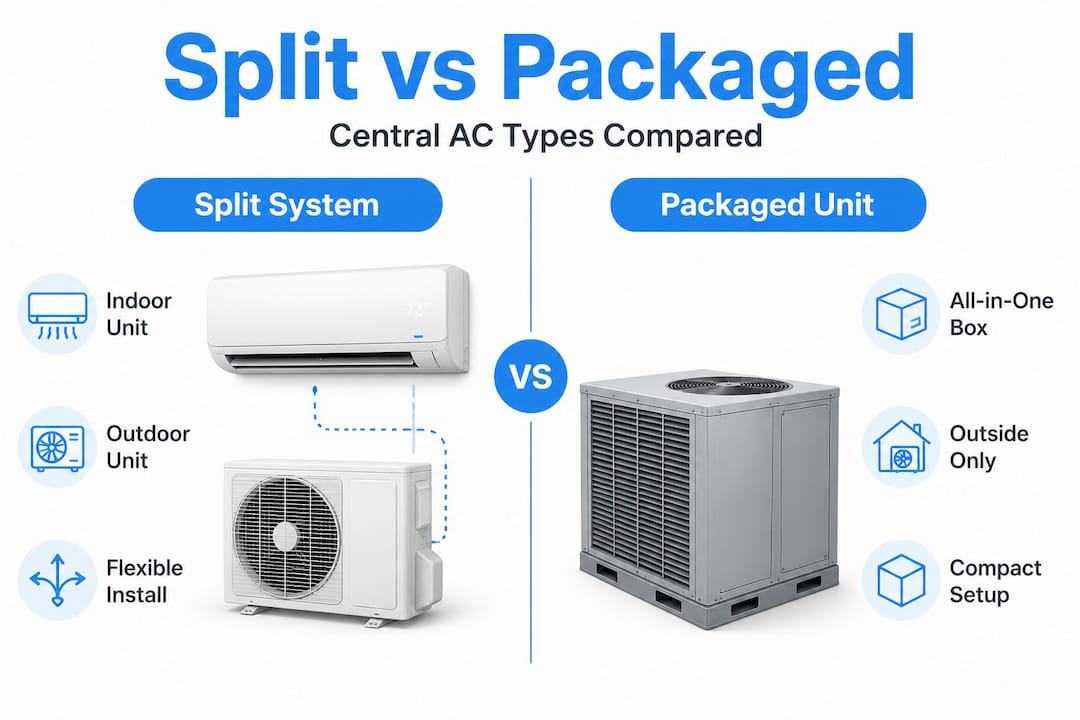
Why this matters for your home: If you are replacing an existing system, you are almost certainly replacing a split system. If you are doing new construction or a major renovation, your contractor should walk you through both options before any purchase decision is made.
How efficiency ratings work: SEER2 and beyond
Efficiency is where homeowners often get confused or misled by marketing. Understanding the numbers puts you in control of the conversation when you’re comparing quotes or buying a new system.
What SEER2 actually measures:
SEER2 stands for Seasonal Energy Efficiency Ratio 2. It measures how much cooling (in BTUs) your AC delivers for every watt-hour of electricity it consumes over an entire season. The higher the number, the more efficient the system. The “2” is not a generation label. It reflects a new test standard introduced in 2023 that more accurately simulates real-world duct resistance, making the ratings slightly lower but more honest than the old SEER scale.
As of 2026, minimum efficiency standards for split systems sit at 13.4 to 14.3 SEER2 depending on region, while ENERGY STAR certification requires 15+ SEER2, and top-performing variable-speed models can reach 26 SEER2. Delaware falls in the North region, so the current federal minimum is 13.4 SEER2 for split systems. Anything you buy new already meets this baseline, but you have real choices above it.
Here is what the efficiency tiers look like in practical terms:
| SEER2 rating | Efficiency tier | Estimated annual savings vs. 13.4 baseline |
|---|---|---|
| 13.4 | Minimum code | Baseline |
| 15.0 | ENERGY STAR | ~10 to 12% |
| 16 to 18 | Good value | ~20 to 25% |
| 20+ | Premium | ~30%+ |
| 26 | Top-of-market | Max savings, variable-speed |
The average home AC uses more than 2,000 kWh per year. A high-SEER2 unit rated 16 or above can cut that by 20 to 30%, which adds up to meaningful savings on your Delmarva Power bill each summer. Variable-speed compressors, which modulate output based on demand rather than switching fully on or off, also perform significantly better at dehumidification. That is a critical advantage during Newark’s muggy July and August.
Pro Tip: Do not make your SEER2 decision in isolation. According to understanding SEER2 ratings, real-world efficiency depends heavily on installation quality, duct condition, and proper sizing. A 20 SEER2 unit installed poorly in an improperly sized home will underperform a correctly installed 16 SEER2 system.
For a closer look at how these numbers connect to long-term costs, our SEER rating guide breaks down payback periods and what Newark homeowners typically see on their utility bills. If you’re weighing a heat pump against a traditional AC, our heat pump vs AC efficiency comparison covers that ground thoroughly.
The takeaway: aim for at least 16 SEER2 in Newark, and seriously consider variable-speed if budget allows. The humidity control benefit alone justifies the upgrade for many homeowners.
Common AC problems and what to do about them
Even the best systems have issues. The difference between a $50 fix and a $600 repair often comes down to catching a problem early or preventing it entirely. Here are the most frequent issues we see in Newark homes.
Top AC problems and their root causes:
- Frozen evaporator coil: Ice forming on the indoor coil usually means either a clogged filter blocking airflow or low refrigerant. Frozen evaporator coils account for roughly 30% of service calls. Turn the system off, let it thaw, and check the filter first.
- Low refrigerant: Refrigerant does not get “used up” like gasoline. If your charge is low, there is a leak somewhere. This requires a licensed technician to find, repair, and recharge the system.
- Dirty condenser coils: The outdoor unit gets coated with grass clippings, cottonwood seeds, and debris every summer. This insulates the coils and makes heat transfer less effective, forcing the system to work harder.
- Capacitor failure: Capacitors help start and run the compressor and fan motors. They fail more frequently in hot weather and are one of the most common components we replace in Newark homes every summer.
- Short-cycling: If your AC turns on and off every few minutes without fully cooling the space, it could be oversized for your home, low on refrigerant, or struggling with a blocked filter. Oversized units are a surprisingly common problem in Newark because some contractors use rule-of-thumb sizing instead of proper calculations.
What you can do yourself:
- Change or inspect filters monthly during cooling season.
- Keep at least two feet of clearance around the outdoor condenser unit.
- Gently rinse condenser coils with a garden hose at the start of the season to clear debris.
- Check that all supply vents are open and unobstructed.
- Keep outdoor unit shade-free for maximum heat rejection.
DIY filter changes every month in summer can prevent up to 70% of service calls, and annual professional service protects your warranty and keeps efficiency where it belongs. That statistic surprises most homeowners, but it makes sense. Airflow is the lifeblood of an AC system, and a clogged filter chokes it off.
“The most expensive AC repair we see is the one that was preventable. A $5 filter change in June can prevent a $400 service call in August.” This is the reality for too many Newark homeowners every summer.
For a deeper walkthrough of specific failure scenarios, our guide on common AC problems covers diagnostics in plain language. If your system is already acting up, AC troubleshooting steps for Newark homeowners gives you a step-by-step process before you call for help. And if you’re not sure when to swap your filter, filter replacement tips explains the signs.
When to stop troubleshooting and call a pro: Anything involving refrigerant, electrical components, or the compressor requires a licensed HVAC technician. Working on these systems without proper tools and credentials is dangerous and can void your equipment warranty.
Sizing, humidity, and installation: Keys to comfort
This is the section most homeowners skip because they assume their contractor will handle it. But understanding what correct sizing and quality installation look like helps you ask better questions, spot red flags, and get a system that actually performs.
Why sizing is not optional:
Manual J is the industry-standard load calculation method used to determine the exact cooling capacity your home needs. It factors in square footage, ceiling height, insulation levels, window area, local climate data, and more. A contractor who gives you a quote based on square footage alone is skipping this step.
An oversized AC unit cools the house quickly but shuts off before it removes enough humidity. In Newark’s summers, that leaves you with a cold but clammy house. An undersized unit runs constantly, never catches up on hot days, and wears out faster. Proper Manual J sizing is the foundation of both comfort and energy efficiency.
Variable-speed systems and Newark’s humidity problem:
Delaware summers are humid. Newark regularly sees dew points above 65°F from June through September, which is the range where most people start feeling uncomfortable regardless of temperature. Variable-speed compressors solve this by running at lower capacity for longer periods, which moves more air across the evaporator coil and wrings out more moisture. Single-stage systems blast air at full power and then stop, which is efficient at cooling temperature but poor at dehumidification.
The benefits of getting sizing and installation right include:
- More consistent temperatures throughout the home with fewer hot or cold spots.
- Lower humidity in every room, not just near the thermostat.
- Reduced runtime at peak efficiency instead of constant full-speed cycling.
- Longer equipment life because the system is not straining beyond its design specs.
- Better return on your investment over the 15 to 20-year life of the equipment.
Pro Tip: Ask every contractor you interview whether they perform a Manual J calculation before pricing the system. If the answer is no or vague, that is a red flag. Proper sizing for your home’s comfort directly affects every dollar you spend on both the equipment and electricity for the next two decades.
Installation quality points that matter:
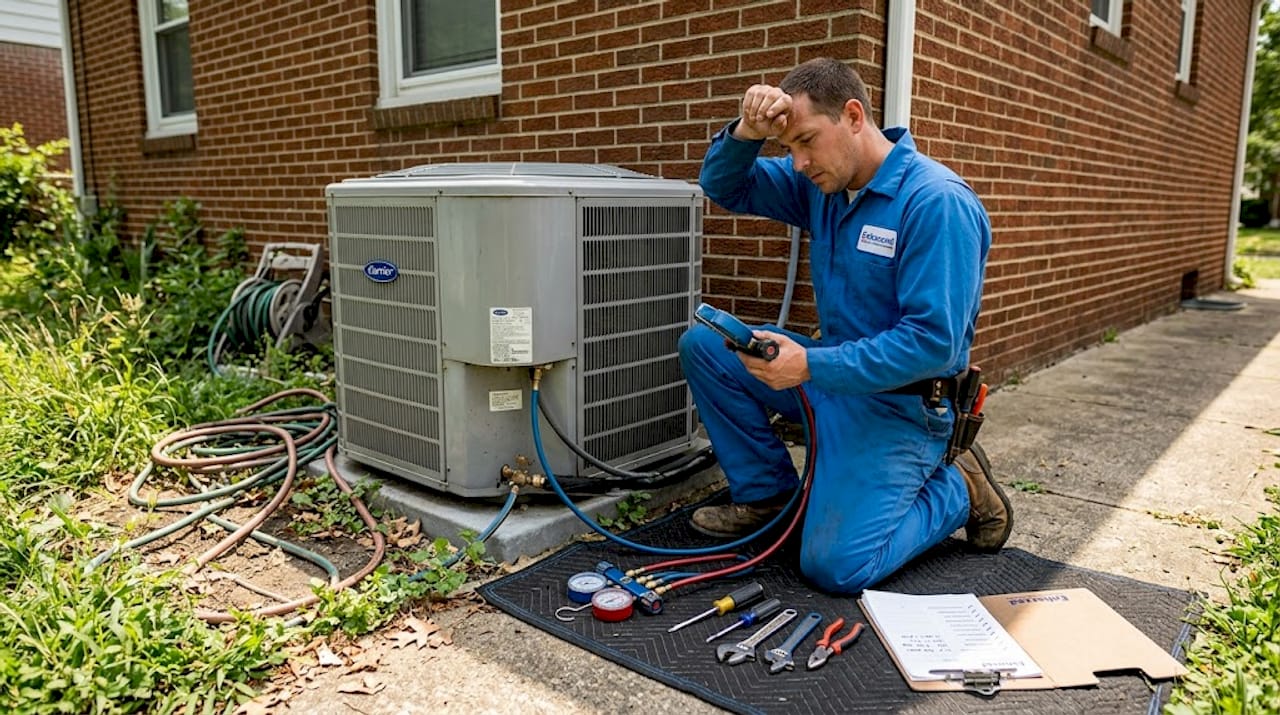
Refrigerant charge must be precisely set after installation. Even a 10% undercharge reduces efficiency significantly. Ducts must be sealed and balanced for even airflow. The thermostat placement affects how the system reads and controls temperature. These details are not extras. They are what separates a good installation from one that will cause headaches. Before summer hits, a professional HVAC tune-up catches any issues left over from winter storage and sets up the system for efficient operation.
Our take: What really matters for Newark homeowners
Here is something we have learned from doing installs and service calls across Newark: homeowners focus on the wrong things when buying a new AC. They obsess over SEER2 numbers and brand names, which is understandable given how equipment is marketed. But in our experience, the single biggest factor in how comfortable your home is and how much you pay to run it is the quality of the installation and the accuracy of the sizing.
We have seen 16 SEER2 systems outperform 20 SEER2 systems in the same neighborhood because one was sized and installed correctly and the other was not. A high-efficiency system with a sloppy refrigerant charge, unbalanced ducts, and wrong sizing is just an expensive disappointment. It will not save you money and it will not keep you comfortable.
Newark’s humidity is the detail that most out-of-town or less-experienced contractors miss. They apply general rules and install systems that cool temperature fine but leave homes feeling muggy and stale. The right equipment for our climate is a variable-speed system sized precisely for your home’s real load. That is not a luxury recommendation. It is what delivers the comfort and savings you are paying for.
We also believe in transparency around cost. A quality installation costs more upfront, but the payback is real. Homes with properly installed, correctly sized systems spend less on repairs, less on electricity, and get more years out of their equipment. The math is not complicated, but you have to be willing to invest in proper sizing and installation rather than just the cheapest bid.
Our honest advice: do not chase the highest SEER2 number your budget can reach. Instead, put that energy into finding a contractor who will size the system properly, seal your ducts, set the refrigerant charge correctly, and stand behind the work. That is what actually moves the needle on your comfort and energy bills.
Get expert help for your central air needs
Now that you have a clear picture of how central AC works, what efficiency ratings mean, and why sizing and installation are so critical, the logical next step is working with someone who gets all of this right the first time.
At Enhanced Heating & Air Conditioning, we serve Newark homeowners with the kind of detailed, transparent approach this article describes. That means proper HVAC installation advice before any equipment is selected, honest load calculations, and service that protects your investment long after install day. Whether you need a new system, a repair on an existing one, or a seasonal tune-up, our team is ready to help. Reach out for local HVAC repair or schedule a free consultation today. Not sure where to start? Our HVAC comfort guide is a great first read.
Frequently asked questions
What’s the difference between split and packaged central air systems?
Split systems have separate indoor and outdoor units connected by refrigerant lines, while packaged systems combine all components in one outdoor cabinet. Most Newark homes use split systems because they integrate easily with existing ductwork and indoor mechanical spaces.
How do I know if my AC’s efficiency is good enough for Newark, DE?
Look for a SEER2 rating of 16 or higher for good savings in Newark’s humid climate. High-SEER2 systems rated 16+ save 20 to 30% annually compared to minimum-code equipment, and variable-speed models add meaningful humidity control during Delaware summers.
What basic maintenance can homeowners do themselves?
Monthly DIY filter changes during summer prevent the majority of AC service calls and keep your system running efficiently. You should also schedule annual professional service to maintain your warranty and catch any refrigerant or electrical issues early.
Why is AC sizing important?
An incorrectly sized AC leads to short-cycling, poor humidity control, and higher energy bills throughout the equipment’s life. Manual J load calculations ensure the system matches your home’s real cooling needs, which is especially important given Newark’s humid summer climate.

Joe Brooks is the owner of Enhanced Heating & Air Conditioning and has more than 23 years of experience serving homeowners and businesses in and around Newark Delaware. Over the past two decades, Joe has built Enhanced Heating & Air Conditioning by helping customers with heating, air conditioning, indoor air quality, HVAC maintenance, and system installation needs. His articles draw on years of hands-on industry experience and the real questions Enhanced customers ask about keeping their homes comfortable, efficient, and reliable. Joe and the Enhanced team serve Newark and communities throughout New Castle County and the surrounding Delaware area.